Yield to Maturity Calculator
Enter the bond price, coupon and dates to get the yield you earn if you hold to maturity.
Free · runs in your browser · nothing is uploaded
Recent
Your last 10 settings, saved only in this browser. Nothing is uploaded.
A yield to maturity calculator finds the yearly return you earn on a bond if you buy at today’s price, receive every coupon and are repaid at maturity. It is the discount rate that makes the present value of the bond’s remaining payments equal its price. It is the number to use when comparing bonds with different coupons and prices.
This yield to maturity calculator, also a bond yield calculator, takes the clean price per 100, the coupon, the settlement and maturity dates and the coupon frequency. It returns the YTM, the current yield, the coupon rate and the accrued interest, and checks the answer by pricing the bond at that yield. The solution is found numerically, as there is no direct formula.
How to use the Yield to Maturity Calculator
- Enter the Settlement date, the day you buy, as YYYY-MM-DD, and the Maturity date.
- Enter the Annual coupon rate as a percentage.
- Enter the Clean price (per 100): the quoted price without accrued interest. A bond bought at par is 100.
- Choose the Coupons per year, usually 2.
- Under More options, change the Redemption value per 100 if the bond redeems at something other than 100, and choose the Day count.
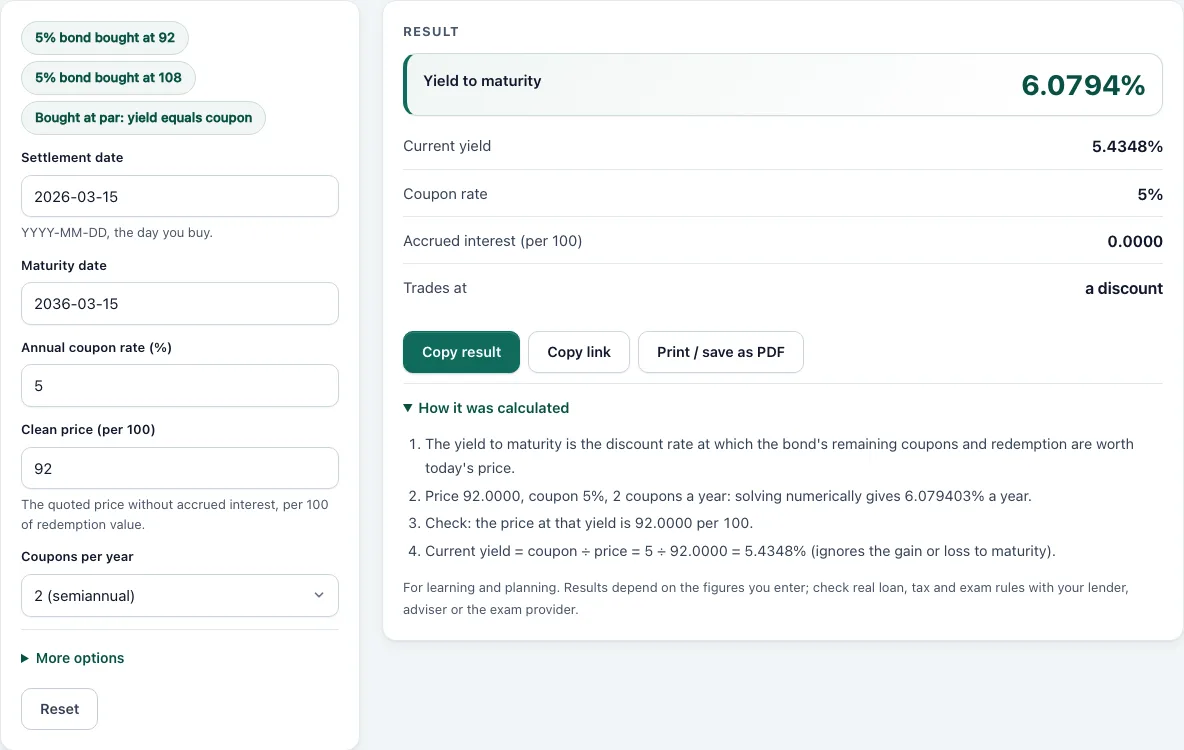
- Read the Yield to maturity, then compare it with the Current yield and the Coupon rate. The Trades at row says premium, discount or par.
- Open How it was calculated to see the definition, the solved yield and the check that the price at that yield equals your price.
The example buttons load a 5% bond bought at 92, one bought at 108 and one bought at par.
Enter the price you would actually pay as the clean price, and compare the YTM with the yield on other bonds of similar risk and maturity to decide which is better value.
Save the price and compare it with the yield from another bond, because yields are directly comparable and prices are not.
Bonds near maturity can have a very high or low yield for a small price difference, so enter the price to as many decimals as your source shows.
What the yield to maturity solves
The YTM y satisfies
Price + accrued = Σ (C ÷ f) ÷ (1 + y ÷ f)^(k − 1 + s) + R ÷ (1 + y ÷ f)^(N − 1 + s)
with s the fraction of the first coupon period still to run. The calculator solves for y by bracketing and refining numerically, then recomputes the price from y as a check.
Worked examples
| Bond | Price | YTM | Current yield |
|---|---|---|---|
| 5% coupon, 10 years left, semiannual | 92 | 6.0794% | 5.4348% |
| same | 108 | 4.0205% | 4.6296% |
| same | 100 | 5% | 5% |
YTM versus current yield
The current yield is coupon ÷ price. It ignores the gain from buying below 100 or the loss from buying above it. At a price of 92 the current yield is 5.4348%, while the YTM, which includes the 8 points you gain by maturity, is 6.0794%. Prefer YTM when comparing bonds.
YTM assumes you hold to maturity, that the issuer pays in full and that you can reinvest coupons at the YTM. Those assumptions are rarely exactly true.
YTM in practice
The yield to maturity is the common language of bond markets. A bond quoted at 92 with a 5% coupon and ten years to run offers 6.0794% if held to maturity, better than its current yield of 5.4348% because the price will rise to 100. A bond at 108 offers 4.0205%, less than its coupon, because the price will fall to 100.
- Compare like with like. Compare YTMs of bonds with similar credit quality and maturity.
- Credit risk. A high YTM often signals that the market sees a risk of default. The calculator assumes all payments are made.
- Reinvestment. The YTM assumes coupons are reinvested at the same rate, which affects long bonds more.
Yield to maturity, current yield and coupon rate
The coupon rate is fixed at issue. The current yield is the coupon divided by the price. The yield to maturity includes the gain or loss to redemption. The three are equal only for a bond at par.
Callable bonds
For a bond that the issuer can redeem early, the relevant measure is yield to call or yield to worst. This calculator can approximate yield to call if you enter the call date as the maturity and the call price as the redemption value.
Reading the check line
After solving, the calculator prices the bond at the yield it found and shows the price. It should match the price you entered to four decimals. If it does not, the bond may have a short first coupon period or a date entered wrongly.
Settlement between coupons
When you buy between coupon dates, the clean price you enter excludes accrued interest. The calculator adds the accrued interest from the day count, discounts all remaining flows and solves for the yield that matches the dirty price. The accrued interest per 100 is shown.
Yield to maturity and risk
Two bonds with the same YTM are not equally good. The one with the longer maturity moves more in price when rates change, and a lower credit rating means a higher chance that the YTM is not achieved. Compare YTM together with maturity and credit quality.
Frequently asked questions
Is YTM the same as the coupon rate?
Only when the bond is bought at par. Below par the YTM is higher than the coupon rate, above par it is lower.
Which price do I enter?
The clean (quoted) price. The calculator adds accrued interest itself where the settlement date falls between coupons.
Why does the answer differ from my broker’s?
Brokers may use another day-count or compounding convention. Try 30/360 and check the coupon frequency.
Does YTM include taxes?
No. It is a pre-tax figure.
What does a negative YTM mean?
You would receive less in coupons and redemption than you pay. It happens when a bond is priced well above its redemption value with a very low coupon.
Is the YTM annualized the same way as my broker’s?
Most use the coupon-frequency compounding used here, such as semiannual. Compare using the same frequency.
Is the YTM the same as the return I will actually get?
Only if you hold to maturity, receive all payments and reinvest coupons at the YTM. Otherwise your realised return differs.
Can I use it for a bond that has just been issued?
Yes. Enter the issue date as the settlement date and the price you pay. At par the yield equals the coupon rate.
- MIRR Calculator: return that avoids the multiple-IRR problem
- XIRR Calculator: annual return of cash flows on specific dates
- CAGR Calculator: the steady growth rate between two values
- Rule of 72 Calculator: years to double, by the rule and exactly
- Bond Price Calculator: clean and dirty price from the yield
- Future Value Calculator: what a sum and regular deposits grow to
- Present Value Calculator: what a future amount is worth today
- The TVMStack app: the planned app that adds cash flows, NPV and IRR
- About the tools: how the results are computed and tested