XIRR Calculator
Paste dated cash flows to get the annualised return, with XNPV at the rate you choose.
Free · runs in your browser · nothing is uploaded
Recent
Your last 10 settings, saved only in this browser. Nothing is uploaded.
An XIRR calculator finds the annual rate of return of cash flows that happen on irregular dates, such as monthly investments of different sizes, a property bought and sold, or a loan with uneven repayments. It is the rate at which the present value of all the flows, discounted by exact days, is zero.
Paste one line per cash flow with a date and an amount; money you pay out is negative. The calculator returns the XIRR, the XNPV at a rate you choose, the net total of the flows and the days covered. If the flows change sign more than once and several rates fit, it lists them so you do not rely on a misleading single number. Everything runs in your browser.
How to use the XIRR Calculator
- In Dated cash flows, write one flow per line as the date and the amount, separated by a comma or a space, for example 2024-01-01, -10000. Dates use the format YYYY-MM-DD.
- Enter money you pay out as negative amounts and money you receive as positive amounts. At least one of each is needed.
- Enter a Rate for XNPV: any annual rate at which you want to see the net present value, for example your target return.
- Read the XIRR (annual). The rows below show the XNPV at that rate, the Net total of the flows and the Days from first to last flow.
- If a warning appears under the results, the flows have more than one XIRR. Compare the rates it lists.
- Open How it was calculated for the definition and a check that the XNPV at the XIRR is zero.
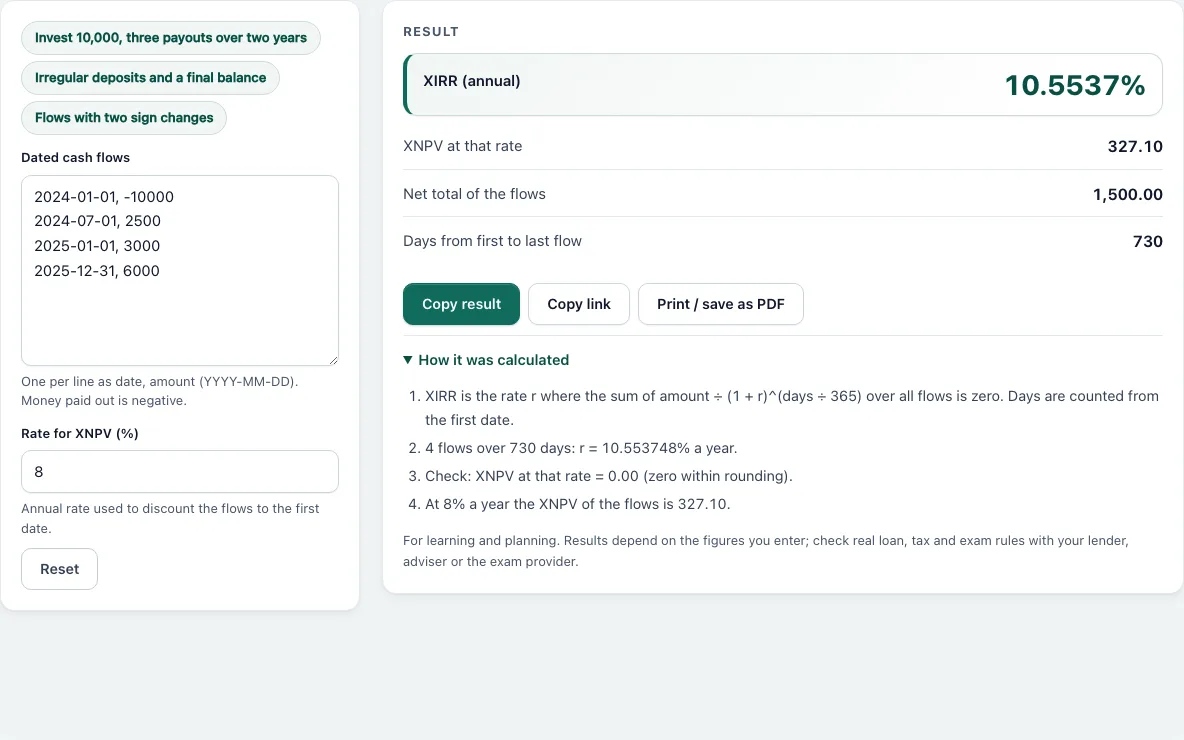
The example buttons load an investment with three payouts, irregular deposits with a final balance and a flow with two sign changes.
Paste values straight from a spreadsheet if each row has a date and an amount; the calculator accepts commas, spaces or tabs between them. Include the final value of the investment as a positive flow on its end date.
XIRR definition
XIRR is the rate r that solves
Σ amount_j ÷ (1 + r)^((date_j − date_0) ÷ 365) = 0
Days are counted exactly from the first date and divided by 365, as spreadsheets do. XNPV is the same sum at a rate you choose.
Worked examples
| Flows | XIRR | XNPV |
|---|---|---|
| 2024-01-01 −10,000; 2024-07-01 2,500; 2025-01-01 3,000; 2025-12-31 6,000 | 10.5537% | 327.10 at 8% |
| 2023-01-15 −2,000; 2023-04-02 −1,500; 2023-11-20 −3,000; 2024-06-30 7,600 | 16.4031% | 715.06 at 5% |
In the first row 1,500 is gained over 730 days; the XIRR is the yearly rate that matches that timing. A single outflow of 100 on 2024-01-01 and 110 on 2025-01-01 has an XIRR slightly below 10%, not exactly 10%, because 2024 is a leap year and its 366 days count as 1.0027 years.
Several rates can fit
If the cash flows change sign more than once, the equation can have several solutions, just as with IRR. The warning lists them. In that case judge the investment by XNPV at your required return, or use the MIRR calculator.
XIRR for common situations
- Regular investing with uneven amounts. List each deposit as a negative amount on its date, and the current value as a positive amount today. The XIRR is your annualised return, which adjusts for when each deposit was made.
- Property. List the purchase price and costs as negative amounts, rent as positive flows and the sale proceeds at the end.
- Loans. From the lender’s side, the XIRR of the amount lent and the repayments is the effective yearly rate.
XIRR versus other measures
A simple return divides the gain by the amount invested and ignores timing. CAGR needs only a start and an end value. XIRR is the one that respects when each flow happens, so it is the right measure for irregular investments. For equally spaced flows, the IRR (periodic) is equivalent.
Troubleshooting
- No answer. All amounts have the same sign, or one is missing.
- A date error. Dates must be written YYYY-MM-DD, and each line must contain exactly one date and one amount.
- A huge or tiny rate. The flows may be nearly all in one direction, or two dates may be very close together; check for a typing mistake in a date or an amount.
- Several rates listed. The cash flows change direction more than once; judge the investment by XNPV at your required rate.
Frequently asked questions
What is the difference between XIRR and IRR?
IRR assumes equal periods between flows. XIRR uses the actual dates, so it suits irregular flows.
Does XIRR give a yearly or monthly rate?
Always an annual rate, compounded yearly.
Why does the calculator need a negative and a positive amount?
A rate of return exists only when money goes out and comes back. All flows in the same direction have no rate.
Does the first date have to be the earliest?
Yes, the first line is time zero and later lines must not be earlier than it.
Why is the XNPV not exactly zero at the XIRR?
It is zero within rounding. The check line shows the remaining difference, which is a fraction of a cent.
Can I use it for SIP returns?
Yes. Enter each monthly instalment as a negative amount with its date and the current value as a positive amount today.
How accurate is XIRR compared with a spreadsheet?
It uses the same actual-days divided by 365 definition as spreadsheet XIRR, but finds every root in a wide range instead of one nearby solution, so it can tell you when the answer is not unique.
Can the last flow be a value I only estimate?
Yes. Add the estimated current value as a positive amount dated today and the XIRR becomes your return to date.
- MIRR Calculator: return that avoids the multiple-IRR problem
- CAGR Calculator: the steady growth rate between two values
- Rule of 72 Calculator: years to double, by the rule and exactly
- Bond Price Calculator: clean and dirty price from the yield
- Yield to Maturity Calculator: the yield implied by a bond price
- Effective Annual Rate Calculator: the yearly rate once compounding is counted
- Loan Amortization Calculator: payment and full repayment schedule
- The TVMStack app: the planned app that adds cash flows, NPV and IRR
- About the tools: how the results are computed and tested