TVM Calculator
Pick the value you want, fill in the other four, and get N, I/Y, PV, PMT or FV with the workings.
Free · runs in your browser · nothing is uploaded
Recent
Your last 10 settings, saved only in this browser. Nothing is uploaded.
A TVM calculator, also called a TVM solver, solves one time-value-of-money problem: you give it four of the five values N (number of periods), I/Y (annual interest rate), PV (present value), PMT (payment each period) and FV (future value), and it finds the fifth. The same five values cover a loan payment, a savings goal, how long money takes to grow and the rate hidden in an instalment offer.
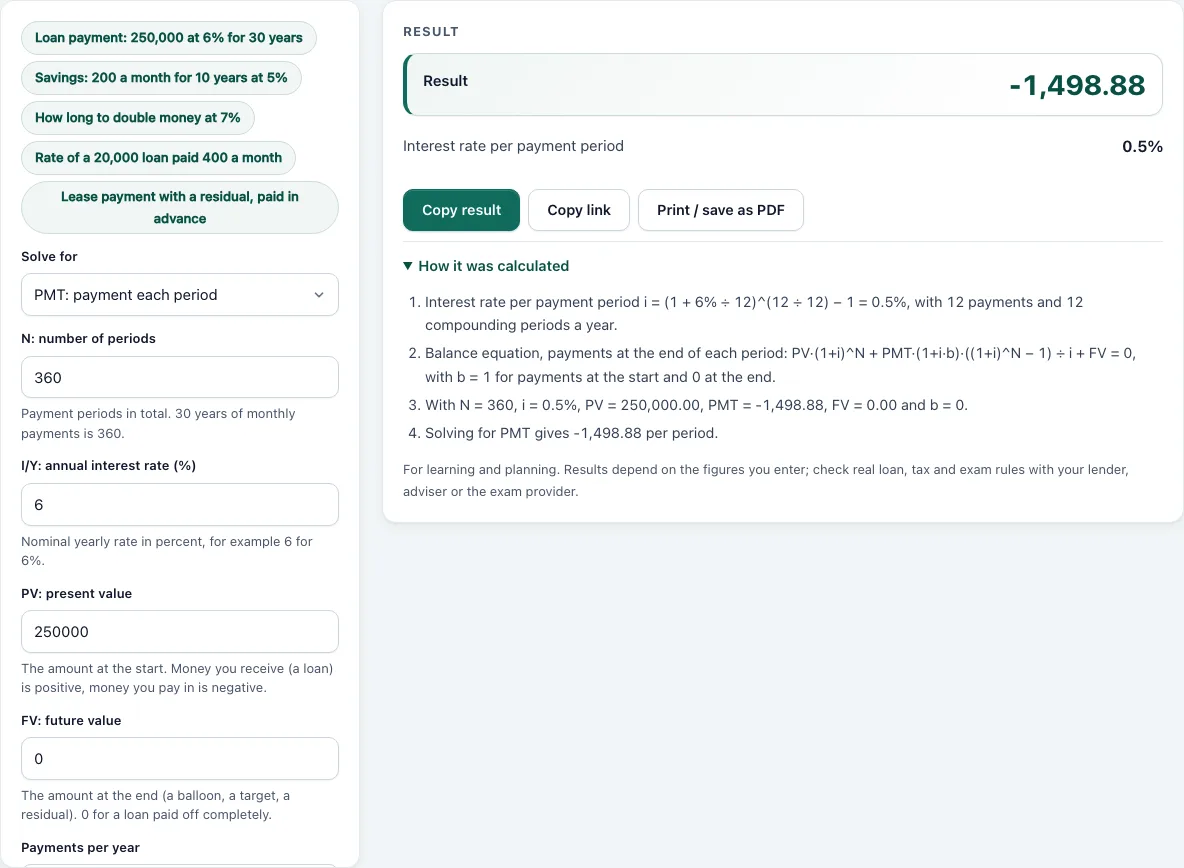
This one shows its work. Under the answer it lists the rate per payment period, the balance equation and your numbers in it, so you can check the result by hand or copy it into your notes. It handles payments at the start or the end of each period, and lets payments per year differ from compounding periods per year. It runs in your browser. Cash-flow lists (NPV, IRR) are not on this page.
How to use the TVM calculator
- In Solve for, choose the value you want: PMT, FV, PV, N or I/Y. That row disappears from the form because it is the answer.
- Fill in the other four values. Money you receive is positive and money you pay out is negative, so a loan you take has a positive PV and negative payments.
- Set Payments per year: 12 for monthly, 4 for quarterly, 1 for yearly. N counts payment periods, so 30 years of monthly payments is 360.
- Tick Payments at the start of each period for an annuity due such as rent or a lease paid in advance.
- Open More options only if the interest compounds at a different frequency from the payments, for example monthly compounding with yearly payments.
- Read the answer, then open How it was calculated for the equation with your numbers. Copy link saves the inputs in the address so you can reopen the same problem.
The example buttons above the form load five typical problems: a 30-year loan payment, monthly savings, doubling time, the rate of an instalment loan and a lease with a residual value. Change any number afterwards and the result updates immediately; there is no Calculate button to press.
What is the time value of money?
A dollar today is worth more than a dollar later, because today’s dollar can earn interest. The TVM equation ties five numbers together: N, I/Y, PV, PMT and FV.
How do I calculate TVM in Excel or on a BA II Plus?
In Excel the functions NPER, RATE, PV, PMT and FV correspond to N, I/Y, PV, PMT and FV. On a Texas Instruments BA II Plus you enter four values on the N, I/Y, PV, PMT and FV keys, then press CPT and the key of the value you want. Both follow the same sign convention as this page: cash you receive is positive and cash you pay is negative.
The TVM balance equation
All five values are tied together by one equation. With i the interest rate per payment period and b equal to 1 for payments at the start of the period and 0 at the end:
PV·(1+i)^N + PMT·(1+i·b)·((1+i)^N − 1) ÷ i + FV = 0
The rate per payment period comes from the annual rate: i = (1 + I/Y ÷ C)^(C ÷ P) − 1, where P is payments per year and C is compounding periods per year. When both are 12, i is simply I/Y ÷ 12. The sign convention is the one financial calculators use: cash you receive is positive, cash you pay is negative, so the five values must balance to zero.
Four of the five unknowns have a direct solution. I/Y does not: the calculator searches for the rate that makes the equation zero and reports when more than one rate fits.
Worked examples
| Problem | Inputs | Answer |
|---|---|---|
| Payment on a 250,000 loan | N 360, I/Y 6%, PV 250,000, FV 0, 12 payments a year | PMT −1,498.88 |
| Value of saving 200 a month | N 120, I/Y 5%, PV 0, PMT −200, 12 payments a year | FV 31,056.46 |
| Years for money to double | I/Y 7%, PV −1,000, FV 2,000, 1 payment a year | N 10.2448 periods |
| Rate of a 20,000 instalment loan | N 60, PV 20,000, PMT −400, FV 0, 12 payments a year | I/Y 7.420096% |
| Lump sum worth 1,000 a year for 20 years | N 20, I/Y 4%, PMT −1,000, FV 0, 1 payment a year | PV 13,590.33 |
For the lease on the example buttons (36 months, 4.8%, 30,000 financed, 18,000 residual value) the monthly payment is 430.57 at the end of each month and 428.86 when paid at the start.
Why I/Y is the hard one to solve
N, PV, PMT and FV can be isolated algebraically. The interest rate cannot, because it sits inside a power. The calculator scans the allowed range for sign changes of the equation and refines each one numerically. If PV, PMT and FV are all positive (or all negative) there is no rate that balances, and it tells you so instead of returning a number.
Frequently asked questions
Which sign should I use for PV, PMT and FV?
Positive for money you receive, negative for money you pay. For a loan you take, PV is positive and PMT is negative. For savings you pay into, PMT is negative and the FV you end up with is positive.
What does N mean when I pay monthly?
N is the number of payment periods, not years. Thirty years of monthly payments is N = 360, with 12 payments per year.
What happens when N comes out fractional?
The answer is the exact number of periods, for example 81.2956 for repaying 10,000 at 6% with 150 a month. In practice that means 81 full payments and a smaller final payment.
Can the interest compound at a different frequency from the payments?
Yes. Set payments per year in the main form and compounding periods per year under More options. The calculator converts the annual rate to the rate per payment period first and shows that conversion in the steps.
Why does the rate per period differ from I/Y divided by 12?
Only when compounding and payments are not both monthly. With 12 payments and 12 compounding periods a year they agree: 6% a year is 0.5% a month. With yearly payments and monthly compounding the effective yearly rate is higher than the nominal one, and the steps show the conversion.
Does this replace a loan quote?
No. Lenders add fees, round payments and may use other day counts. Use the result to understand and compare offers, and take the exact figure from the lender’s schedule.
- Future Value Calculator — what a sum and regular deposits grow to
- Present Value Calculator — what future money is worth today
- Loan Amortization Calculator — the payment and the full repayment schedule
- Annuity Calculator — present value, future value or payment of level payments
- Effective Annual Rate Calculator — the yearly rate behind a nominal rate and its compounding
- Japan FP six coefficients calculator — the same compound-interest idea in the form used by the Japanese financial planner exams
- The TVMStack app — adds cash flows, NPV and IRR, schedules and exports (planned)
- About the tools — how results are computed and tested