Sinking Fund Calculator
Enter the target, the rate and the time, and get the deposit to make each period.
Free · runs in your browser · nothing is uploaded
Recent
Your last 10 settings, saved only in this browser. Nothing is uploaded.
A sinking fund is money set aside in regular deposits to pay for something later, such as replacing equipment, repaying a bond or saving for a house deposit. This sinking fund calculator works out the deposit each period that, with interest, grows to your target by the date you need it.
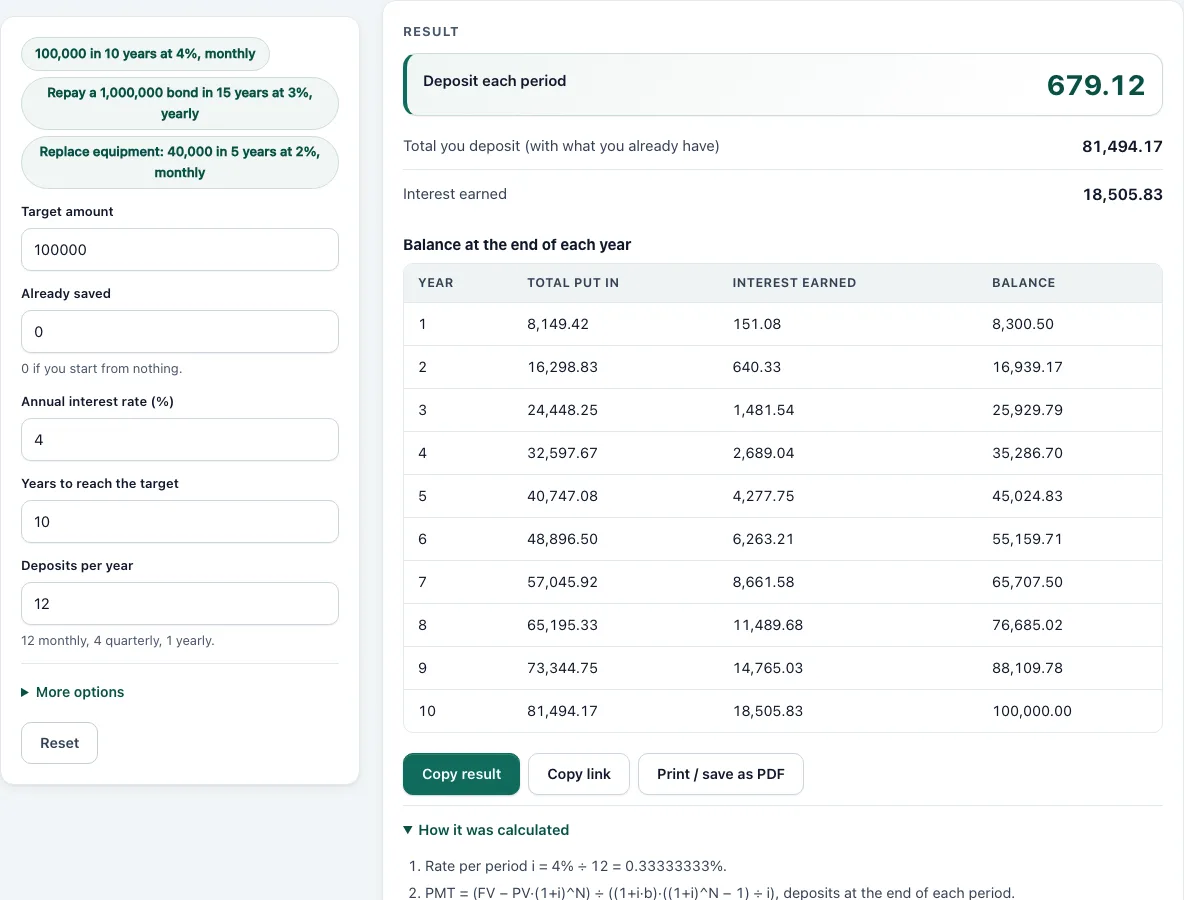
You can include an amount already saved, choose how often you deposit, and pay in at the start or the end of each period. The calculator shows the deposit, how much of the target is your own money and how much is interest, together with the equation and a table of the balance at the end of each year.
How to use the Sinking Fund Calculator
- Enter the Target amount you need at the end.
- Enter Already saved if you have a starting balance, or 0.
- Enter the Annual interest rate the fund earns.
- Enter the Years to reach the target.
- Set Deposits per year: 12 for monthly, 4 for quarterly, 1 for yearly.
- Under More options, tick the box if you deposit at the start of each period.
- Read the Deposit each period, the total you deposit and the interest earned. Open How it was calculated for the equation. The table shows the balance at the end of each year.
The example buttons load saving for a house deposit, repaying a bond and replacing equipment.
If the deposit is more than you can afford, lengthen the time, lower the target or look for a higher rate, and run the calculator again to see which lever works best.
Compare two plans by running the calculator twice: the same target over 5 and 10 years shows how much a longer horizon lowers the deposit.
The deposit is level. If you would rather pay a rising amount, run the calculator for the first years and again for the rest with the balance you have reached as the starting amount.
Sinking fund formula
With a target FV, a rate i per period, N deposits and a starting balance PV, the deposit is:
PMT = (FV − PV·(1+i)^N) ÷ (((1+i)^N − 1) ÷ i)
The denominator is the future value of one unit deposited every period. At 0% interest the deposit is simply the amount still needed divided by N.
Worked examples
| Target | Rate | Years | Deposits | Already saved | Deposit |
|---|---|---|---|---|---|
| 100,000 | 4% | 10 | monthly | 0 | 679.12 |
| 100,000 | 4% | 10 | monthly | 20,000 | 476.63 |
| 1,000,000 | 3% | 15 | yearly | 0 | 53,766.58 |
| 40,000 | 2% | 5 | monthly | 0 | 634.44 |
In the first row you deposit 81,494.17 in total and interest provides the remaining 18,505.83.
For a company that wants 40,000 in five years to replace machinery, a 2% savings rate and monthly deposits give 634.44 a month. The deposits add up to 38,066.62 and interest provides 1,933.38. At a 0% rate the deposit would be 666.67, so interest saves 32.23 a month here, a small effect at a low rate.
Savings goal calculator: how much to save each month
To reach a savings goal, enter the goal as the target, the savings rate and the years, and read the deposit. For a goal of 10,000 in 3 years at 4% a year with monthly deposits at the end of each month, you save 261.91 a month. The 36 deposits add up to 9,428.63 and interest adds the remaining 571.37. If you already have money set aside, enter it as the starting balance and the monthly amount falls.
Sinking fund factor
The Japanese financial planner exams call the part 1 ÷ (((1+r)^n − 1) ÷ r) the sinking fund factor, 減債基金係数, and use a printed table of it. The Japan FP six coefficients calculator computes it for any rate and shows the table value next to the exact one.
Planning with a sinking fund
A sinking fund works best when the cost and the date are known: a roof replacement in ten years, a vehicle fleet renewal, repayment of a bond. The calculator shows what regular deposits can achieve; reality adds a few things to check.
- Cost inflation. The target is a fixed number. If the item will cost more in future, enter the inflated amount.
- Interest rate risk. A fund invested in a deposit account earns a variable rate. Run the calculator at a low rate to see a prudent deposit.
- Taxes on interest. Use the after-tax rate.
- Starting balance. Entering what you have already saved shows how much the deposit falls: in the example above, 20,000 already saved cuts the monthly deposit from 679.12 to 476.63.
Sinking fund and bond repayment
Companies and governments have used sinking funds to repay bonds without a single large payment at maturity. The payment each period in this calculator is the amount that, with interest, repays the principal on schedule, which is the same arithmetic that business textbooks use. An issuer who must repay 1,000,000 in 15 years can deposit 53,766.58 a year at 3% to reach it. Real funds may buy back bonds early, which changes the timing.
Starting balance and time
An existing balance does double duty: it grows by compound interest and it reduces what remains to be saved. In the first example, 20,000 already saved cuts the monthly deposit by almost 30%. Time works the same way: the same 100,000 target over 15 years at 4% needs a lower deposit than over 10 years.
Frequently asked questions
What is the difference between a sinking fund and a savings account?
A sinking fund is a savings plan with a fixed purpose and date. The arithmetic is the same: regular deposits plus interest.
What if I already have more than the target needs?
If the starting balance alone grows to the target, no deposit is needed and the calculator says so.
Do bond issuers use sinking funds?
Yes. A company can deposit regularly so it can repay a bond at maturity. This calculator gives the deposit for a given interest rate.
Can I change the deposit amount later?
Not in one calculation. Run it again with what you have saved as the starting amount and the years that remain.
Is a sinking fund the same as an emergency fund?
No. An emergency fund is for the unexpected and has no target date. A sinking fund is for a known future cost.
Should I deposit at the start or the end of the period?
At the start if you can: each deposit then earns one more period of interest, which lowers the deposit you need.
Can I use it to save for retirement?
For a known target amount, yes. For retirement income, it is more useful to work from the withdrawals you want, with the annuity calculator.
- TVM Calculator: solve any one of N, I/Y, PV, PMT or FV
- Future Value Calculator: what a sum and regular deposits grow to
- Present Value Calculator: what a future amount is worth today
- Annuity Calculator: value or payment of level and growing payments
- Perpetuity Calculator: value of payments that never end
- Bond Price Calculator: clean and dirty price from the yield
- Yield to Maturity Calculator: the yield implied by a bond price
- The TVMStack app: the planned app that adds cash flows, NPV and IRR
- About the tools: how the results are computed and tested