Rule of 72 Calculator
Enter a yearly return to see how many years it takes to double, by the rule and exactly.
Free · runs in your browser · nothing is uploaded
Recent
Your last 10 settings, saved only in this browser. Nothing is uploaded.
A rule of 72 calculator checks a mental shortcut: divide 72 by the yearly return, in percent, to estimate how many years it takes money to double. At 8% it is 72 ÷ 8 = 9 years. The shortcut works because the exact doubling time, ln 2 divided by ln(1 + rate), is close to 72 divided by the rate for ordinary rates.
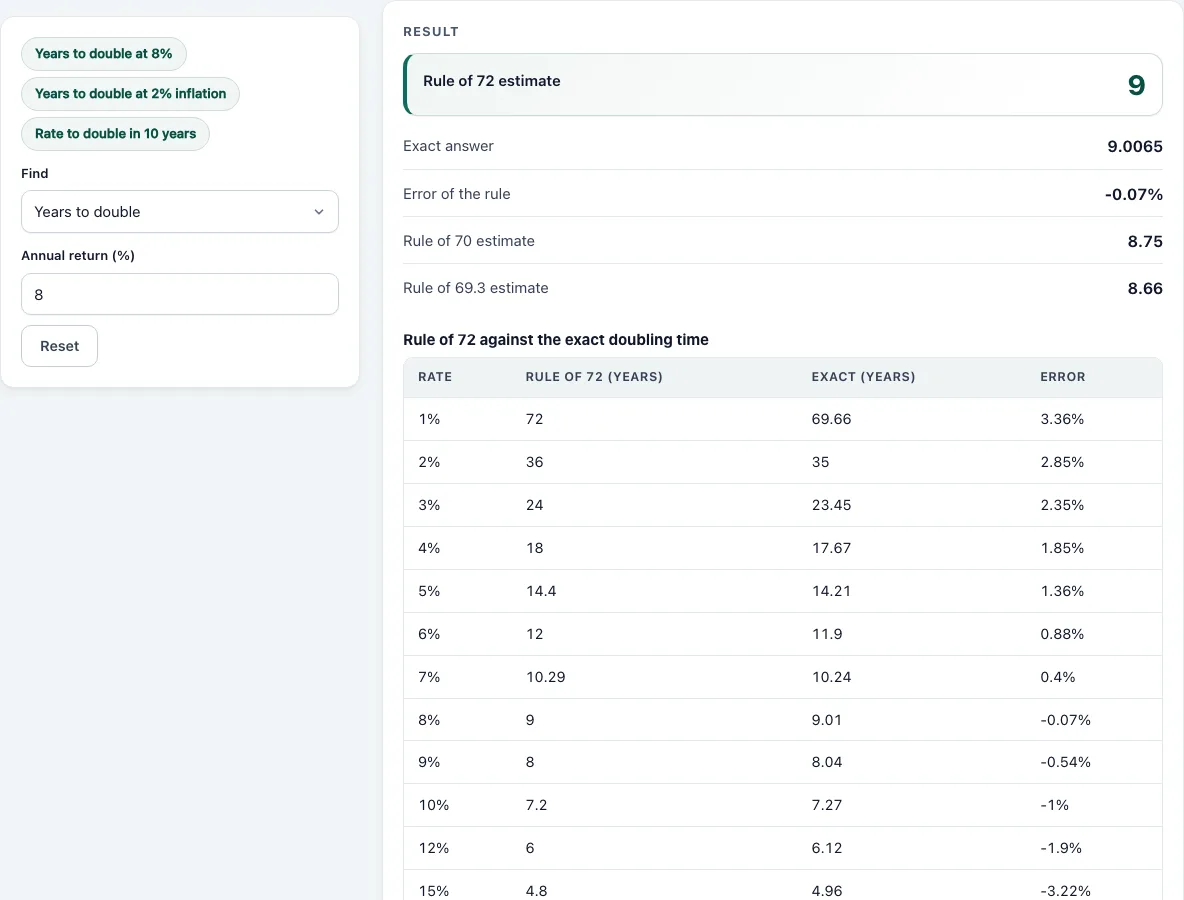
This rule of 72 calculator gives the estimate and the exact answer side by side, with the error of the rule, and compares the rules of 70 and 69.3. It also works the other way: the rate you need to double in a set number of years. A table shows how the rule behaves from 1% to 30%.
How to use the Rule of 72 Calculator
- In Find, choose Years to double or Rate needed to double.
- For years to double, enter the Annual return as a percentage, for example 8. For the rate, enter the Years to double.
- Read the Rule of 72 estimate at the top and the Exact answer below it.
- The Error of the rule shows how far the estimate is from the exact figure, as a percentage of the exact figure.
- The rows for the Rule of 70 and Rule of 69.3 show the same estimate with those numbers.
- Open How it was calculated for both formulas with your numbers.
- The table lists the rule and the exact doubling time for common rates, so you can see where the rule is most accurate.
The example buttons load the years to double at 8%, at 2% inflation, and the rate to double in 10 years.
The tool is most useful for comparison. Run it with a few rates, for example the return of your savings and the rate of inflation, to see how quickly each doubles money or prices.
Try the rate mode with a target you have in mind: the rate needed to double in 5 years is about 14.4%, and in 20 years about 3.6%.
The rule and the exact formula
- Rule of 72: years ≈ 72 ÷ rate (in percent)
- Exact: years = ln 2 ÷ ln(1 + rate)
- Rate to double in n years: (2^(1/n) − 1) × 100
Worked examples
| Input | Rule of 72 | Exact |
|---|---|---|
| 8% a year | 9 years | 9.0065 years |
| 2% a year | 36 years | 35.0028 years |
| 1% a year | 72 years | 69.6607 years |
| double in 10 years | 7.2% a year | 7.1773% a year |
Which number should I use: 72, 70 or 69.3?
72 is best for rates around 8% and is easy to divide. 70 is more accurate at 2–3%, such as inflation, and 69.3 is the best for very low rates or continuous compounding. The calculator shows all three, and the table shows the exact doubling time for comparison.
Where the rule comes from
Doubling money means (1 + r)^n = 2, so n = ln 2 ÷ ln(1 + r). For small r, ln(1 + r) is close to r, and ln 2 is about 0.693, so n ≈ 69.3 ÷ r with r in percent. The number 72 compensates for the fact that ln(1 + r) is smaller than r at ordinary rates, and it divides evenly by many integers.
- Best range. The rule of 72 is closest to the exact value at about 8%.
- Low rates. Below about 5%, 70 or 69.3 are more accurate; at 1% the rule of 72 is 3.4% too high.
- High rates. At very high rates, such as 30%, the error rises, and 72 over-estimates the years.
Uses of the rule
- Investing. At 6% money doubles in 12 years; at 9% in 8 years.
- Inflation. At 3% inflation, prices double in 24 years.
- Debt. A balance growing at 18% with no payments doubles in 4 years.
- Growth targets. A company growing 12% a year doubles in 6 years.
Beyond doubling
The same idea gives other multiples: dividing 114 by the rate approximates the years to triple, and 144 to quadruple. For exact answers at other multiples, use the CAGR calculator in years mode.
Mental maths with the rule
Dividing 72 by the rate is easy for the common rates 2, 3, 4, 6, 8, 9, 12 and 18, which are all factors of 72. At 6% the answer is 12 years. At 9% it is 8 years. For a rate such as 7%, divide 72 by 7 to get 10.3 years, against an exact 10.24 years.
Rule of 72 and inflation
The rule helps to see how inflation erodes money. At 4% inflation prices double in 18 years, so a fixed income loses half its buying power over that time. At 7% prices double in about 10 years. The estimate and the exact figure are shown side by side, so you can see the small difference.
Where the rule fails
The rule assumes one compounding period a year and a constant rate. Returns that vary from year to year, fees and taxes all change the real doubling time. Use the CAGR calculator with your actual values for a precise answer.
Frequently asked questions
How accurate is the rule of 72?
Within about 1% for rates from 6% to 10%. At 1% it is 3.4% off, and at 30% it is off by more.
Why 72 and not 69?
The exact constant for continuous compounding is 69.3. 72 is used because it has many divisors (2, 3, 4, 6, 8, 9, 12), which makes mental arithmetic easy, and it is closer for rates around 8%.
Can I use it for inflation or debt?
Yes. At 3% inflation prices double in about 24 years. A debt growing at 12% with no payments doubles in 6 years.
Does it work for tripling?
Use 114 divided by the rate for tripling. The calculator on this page covers doubling only.
Does the rule work for decreasing values?
For a value falling at a steady rate, the same figure gives the halving time: money losing 3% a year to inflation halves in about 24 years.
What if the rate is below 1%?
The rule still works but loses precision; the exact answer shown next to it is the one to use.
Is the rule of 72 only for investments?
No. It applies to anything growing at a steady percentage: prices, populations, a debt that accrues interest or a business’s sales.
What rate do I use for savings accounts?
Use the effective annual rate, since the rule assumes yearly compounding. The effective annual rate calculator converts a quoted rate for you.
- MIRR Calculator: return that avoids the multiple-IRR problem
- XIRR Calculator: annual return of cash flows on specific dates
- CAGR Calculator: the steady growth rate between two values
- Bond Price Calculator: clean and dirty price from the yield
- Yield to Maturity Calculator: the yield implied by a bond price
- Present Value Calculator: what a future amount is worth today
- Annuity Calculator: value or payment of level and growing payments
- The TVMStack app: the planned app that adds cash flows, NPV and IRR
- About the tools: how the results are computed and tested