Present Value Calculator
Enter the future amount, the discount rate and the years to see what it is worth today.
Free · runs in your browser · nothing is uploaded
Recent
Your last 10 settings, saved only in this browser. Nothing is uploaded.
A present value calculator tells you what a sum of money you will receive later is worth today. Money in the future is worth less than the same amount now because you could earn interest on it, so the calculator discounts the future amount by your chosen rate.
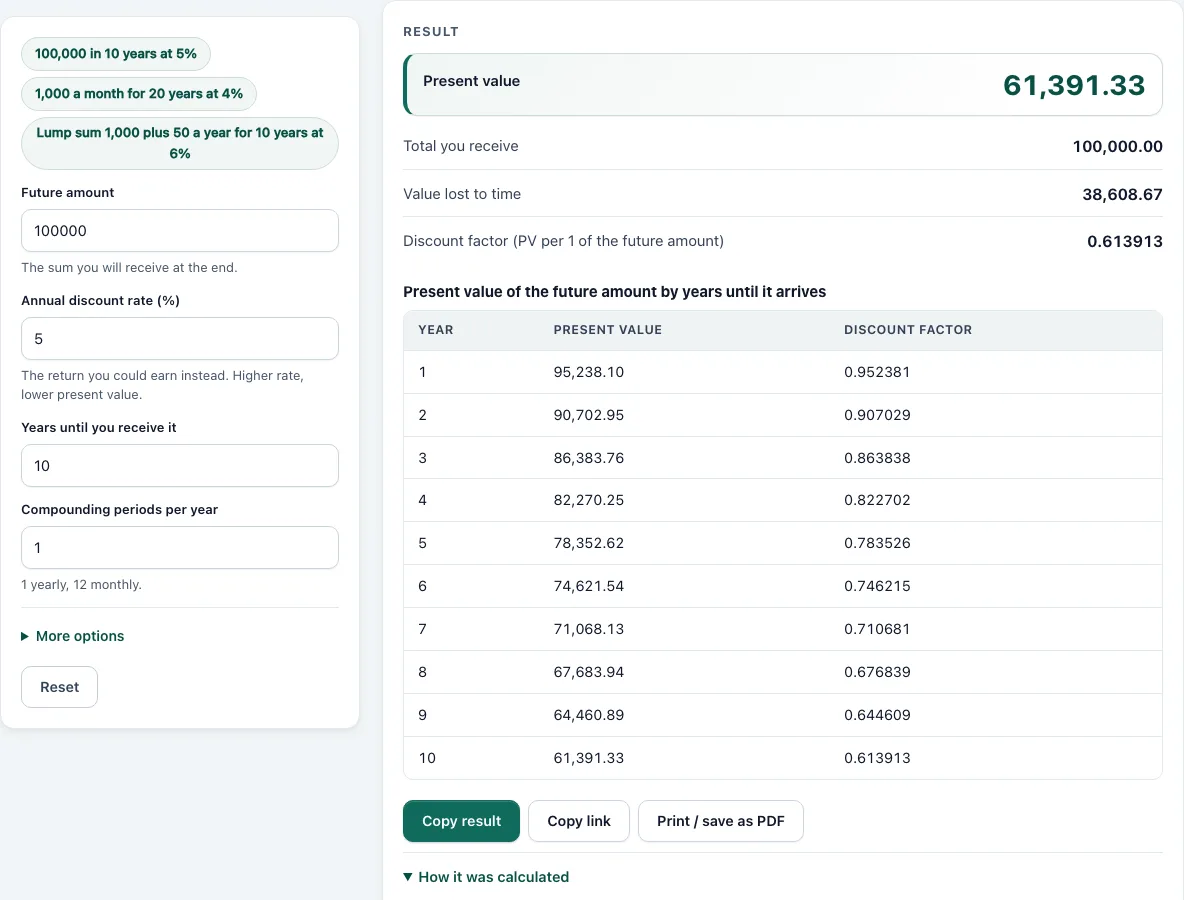
Enter the future amount, the annual discount rate and the number of years. You can also add a regular payment received each period, which turns it into the value of an income stream plus a final sum. The answer comes with the discount factor, the value lost to time and the equation with your numbers, and a table shows the present value for each possible waiting time.
How to use the Present Value Calculator
- Enter the Future amount: the sum you will receive at the end. Use 0 if you only want the value of regular payments.
- Enter the Annual discount rate. This is the return you could earn on the money instead, for example 5.
- Enter the Years until you receive it.
- Set the Compounding periods per year: 1 for yearly, 12 for monthly. It also sets how often any regular payment is received.
- Under More options, enter a Regular payment received each period if there is one, and tick the box if payments arrive at the start of each period.
- Read the Present value and the Discount factor, the share of the future amount that is worth something today.
- Open How it was calculated to see the equation with your numbers. The table shows the present value if the same amount arrived after 1, 2, 3 … years.
The example buttons load a lump sum, a pension stream and a bond-style set of payments.
To compare two offers, such as 90,000 today against 100,000 in two years, enter the later sum with your discount rate and compare the present value with the amount you are offered now.
Because the compounding setting also sets how often a regular payment is received, leave it at 1 for yearly cash flows and 12 for monthly ones.
Present value formula
For a single future amount FV received after N periods at a rate i per period:
PV = FV ÷ (1+i)^N
The part (1+i)^−N is the discount factor. If you also receive a payment PMT each period, add PMT·(1 − (1+i)^−N) ÷ i. The calculator solves the combined equation and reports it as one number.
Worked examples
| Future amount | Payments | Rate | Years | Present value |
|---|---|---|---|---|
| 100,000 | none | 5% | 10 | 61,391.33 |
| 0 | 1,000 a month | 4% | 20 | 165,021.86 |
| 1,000 | 50 a year | 6% | 10 | 926.40 |
The first row means 100,000 in ten years is worth 61,391.33 today at 5%, a discount factor of 0.613913. The third row is the price of a ten-year bond with a 5% coupon when the required return is 6%, which sells below its face value of 1,000.
Choosing a discount rate
The result depends heavily on the rate. A higher rate shrinks the present value, so use the return you could realistically earn on a similar-risk alternative. Compare results at two rates to see how sensitive the answer is.
Present value in practice
Present value turns amounts at different dates into amounts at one date, today, so they can be compared or added. It is the basis of net present value for projects, the price of a bond, the value of a lump-sum settlement against an annuity and the fair value of a pension.
- Lump sum or instalments? Calculate the present value of the instalments at your discount rate. If it is higher than the lump sum offered, the instalments are worth more.
- Choosing the rate. The higher the rate, the lower the present value. A rate that reflects your best alternative use of the money is the right one; for a risky amount, add a premium.
- Time matters more than it looks. At 5%, 100,000 due in 10 years is worth 61,391.33 now, but due in 20 years it is worth only 37,688.95.
Present value and net present value
Net present value (NPV) is the present value of everything a project returns minus its cost. A positive NPV means the project earns more than the discount rate. For a list of uneven cash flows with dates, use the XIRR calculator, which shows the XNPV at a rate of your choice.
Frequently asked questions
What discount rate should I use?
Use the return you could earn on a comparable investment with the same risk, such as a savings rate for a safe amount or a higher rate for a risky one.
Is present value the same as net present value?
Net present value subtracts the cost of an investment from the present value of what it returns. This page gives the present value of the receipts only.
What does a discount factor of 0.61 mean?
Each unit received in the future is worth 0.61 units today. Multiply any future amount by the factor to get its present value.
Can the rate be negative?
This calculator accepts rates from 0% up. A negative rate would make the future amount worth more than its face value today.
How do I compare a lump sum with payments over time?
Enter the payments as the regular payment and the final amount as the future amount, then compare the present value with the lump sum.
Is present value affected by inflation?
Indirectly. A nominal discount rate already includes the inflation you expect; use a real rate only if your future amount is in today’s money.
Can I discount monthly payments at an annual rate?
Yes: enter the annual rate and set the compounding periods to 12, and the calculator converts it to a monthly rate for you.
- TVM Calculator: solve any one of N, I/Y, PV, PMT or FV
- Future Value Calculator: what a sum and regular deposits grow to
- Annuity Calculator: value or payment of level and growing payments
- Perpetuity Calculator: value of payments that never end
- Sinking Fund Calculator: the deposit that reaches a target
- Depreciation Calculator: yearly write-down by three methods
- Loan Amortization Calculator: payment and full repayment schedule
- The TVMStack app: the planned app that adds cash flows, NPV and IRR
- About the tools: how the results are computed and tested