Perpetuity Calculator
Find the value, payment or rate of a payment stream that goes on forever.
Free · runs in your browser · nothing is uploaded
Recent
Your last 10 settings, saved only in this browser. Nothing is uploaded.
A perpetuity calculator values a payment that continues forever, such as a preferred share dividend or a fixed income from an endowment. Its value is the payment divided by the discount rate, because the payments go on indefinitely and each is worth less than the one before.
This perpetuity calculator finds the present value, the payment that a given price supports, or the rate implied by a price and payment. It also handles a growing perpetuity, where the payment rises by a fixed percentage each period, and a perpetuity due, where the first payment is today. The formula appears with your numbers beside every answer.
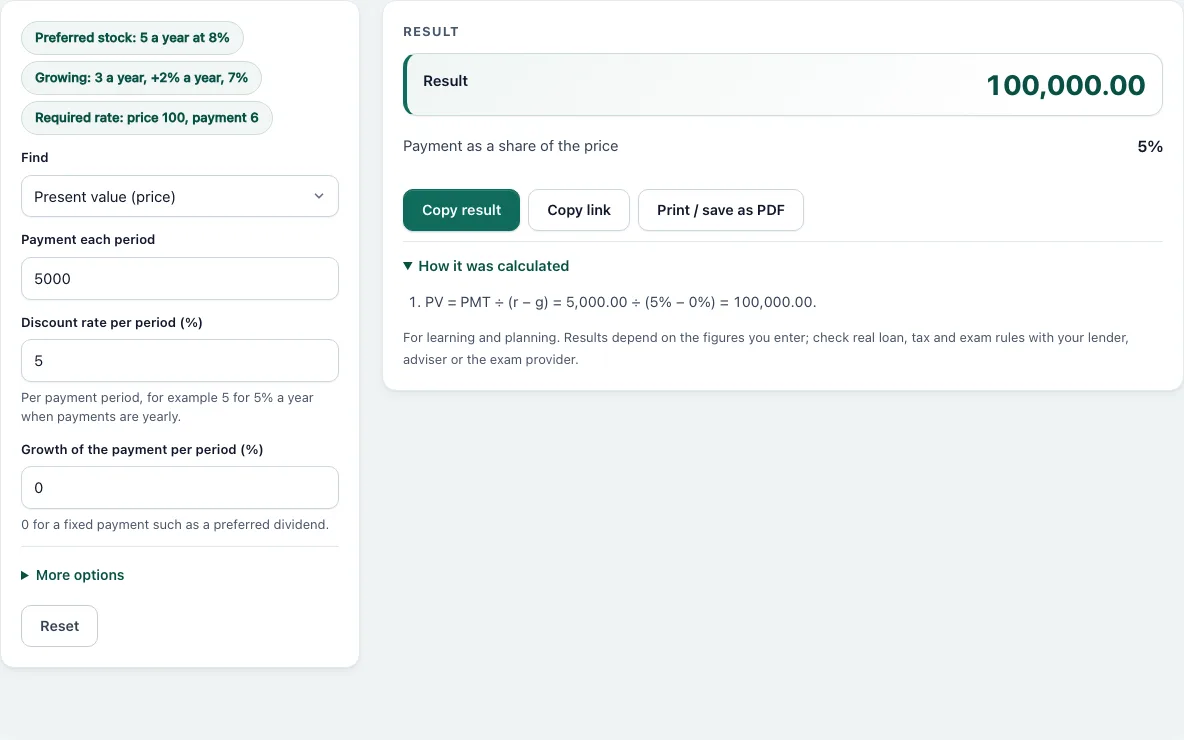
How to use the Perpetuity Calculator
- In Find, choose the present value (price), the payment from a price, or the rate from a price and payment.
- Enter the Payment each period or the Present value, whichever is not being solved.
- Enter the Discount rate per period. For yearly payments this is the annual rate, for example 8.
- Enter the Growth of the payment per period. Leave 0 for a fixed payment.
- Under More options, tick First payment today if the first payment is paid now rather than one period from now.
- Read the result and the share of the price the payment represents, then open How it was calculated for the formula.
The example buttons load a preferred share, a growing payment and a required-rate problem.
If the answer looks too high, check that the rate and the growth use the same period. A yearly growth rate and a monthly discount rate will give a wrong value.
Use the same period for the payment, the rate and the growth. If payments are monthly, use a monthly rate, which is the annual rate divided by 12.
The rate is per payment period. For quarterly payments divide the annual rate by four, and use a quarterly growth rate as well.
Perpetuity formulas
With a payment P, a discount rate r and a growth rate g per period (g = 0 for a fixed payment):
- Present value: PV = P ÷ (r − g), with the first payment one period from now.
- If the first payment is today: PV = P·(1 + r) ÷ (r − g).
- Payment from a price: P = PV·(r − g).
- Rate from a price: r = P ÷ PV + g.
The formulas only work when r is greater than g. If growth is at least the discount rate, the value is infinite.
Worked examples
| Case | Inputs | Result |
|---|---|---|
| Preferred share | payment 5, rate 8% | 62.50 |
| Growing payment | payment 3, rate 7%, growth 2% | 60.00 |
| Required rate | price 100, payment 6 | 6% |
| Payment from a price | price 100,000, rate 5% | 5,000.00 |
Where a perpetuity is used
Perpetuities appear in valuation: the terminal value of a business is often a growing perpetuity of its cash flow. Because the answer depends so strongly on r − g, a small change in either number moves the value a lot. Try the same inputs with the rate 1 point higher to see it.
Perpetuities in valuation
The growing perpetuity formula is the Gordon growth model: a share worth its next dividend divided by the required return minus the growth rate. It is also used for the terminal value in a discounted cash flow model, where the cash flow after the forecast period is assumed to grow forever at a modest rate.
- Sensitivity. Because the value depends on the gap between r and g, a gap of 2 points gives twice the value of a gap of 4 points.
- Realistic growth. A growth rate above the long-run growth of the economy cannot last forever. Many analysts cap g at 2–3%.
- Preferred shares and annuities from endowments are the closest real examples of fixed perpetuities.
Limits of the model
A perpetuity ignores the risk that payments stop, taxes and changes in the rate. Use it for a quick estimate and compare with a finite annuity of 30 to 50 years: the two values are often close, which shows how little the far future adds at a high discount rate.
Worked example: preferred share
A preferred share pays 5 a year and the required return is 8%. The value is 5 ÷ 0.08 = 62.50. If the market price is 55, the implied return is 5 ÷ 55 = 9.09%, higher than the 8% required, so the share looks cheap against that benchmark. Use the rate mode to find the implied return from a price.
Perpetuity compared with an annuity
A 30-year annuity of 5 a year at 8% is worth 56.29, and the perpetuity is worth 62.50. The payments after year 30 add only 6.21 to the value, which shows how little the distant future contributes at a high discount rate. At a low discount rate the difference is much larger, which is why valuations are so sensitive to the rate.
Timing of the first payment
The standard formula assumes the first payment comes one period from now. If the first payment is today, as with some rents and dividends, the value is higher by a factor of (1 + r). The checkbox under More options applies this.
Frequently asked questions
Why does the discount rate have to be higher than growth?
If payments grow at least as fast as they are discounted, each payment is worth as much as or more than the last, and the total never stops growing.
What is a growing perpetuity?
A payment stream that rises by a fixed percentage every period forever. The Gordon growth model for share prices is one.
Is a perpetuity realistic?
Few payments last forever, but a very long stream behaves like one. A 50-year annuity is already close to the perpetuity value.
How is this different from an annuity?
An annuity ends after a set number of payments. For a stream that does end, use the annuity calculator.
What does the yield row mean?
It is the first payment divided by the price: the cash return on the price before growth. For a fixed perpetuity it equals the discount rate.
Can I use it to value a share?
For a stable dividend payer, yes: enter the next dividend, your required return and the dividend growth rate. Treat the result as a rough guide, not a price target.
What is the perpetuity formula in one line?
Present value = payment ÷ (rate − growth). With no growth it is payment ÷ rate.
- TVM Calculator: solve any one of N, I/Y, PV, PMT or FV
- Future Value Calculator: what a sum and regular deposits grow to
- Present Value Calculator: what a future amount is worth today
- Annuity Calculator: value or payment of level and growing payments
- Sinking Fund Calculator: the deposit that reaches a target
- XIRR Calculator: annual return of cash flows on specific dates
- CAGR Calculator: the steady growth rate between two values
- The TVMStack app: the planned app that adds cash flows, NPV and IRR
- About the tools: how the results are computed and tested