Japan FP Six Coefficients Calculator
Choose the question, enter an amount, a rate and the years, and get the coefficient and the answer, with the table rounding used in the exams.
Free · runs in your browser · nothing is uploaded
Recent
Your last 10 settings, saved only in this browser. Nothing is uploaded.
The Japan FP six coefficients are the compound-interest multipliers behind the Japanese financial planner (FP) exams: 終価係数 (future value), 現価係数 (present value), 年金終価係数 (annuity future value), 減債基金係数 (sinking fund), 年金現価係数 (annuity present value) and 資本回収係数 (capital recovery). Pick the question you are asking, enter an amount, an annual rate and the years, and see which coefficient applies, its value and the answer in yen.
The coefficient is shown as the exam tables print it, with a switch for the unrounded value. A second mode compares an equal payment (元利均等) and an equal principal (元金均等) loan. The Japanese version runs the same calculation, and every answer lists the formula with your numbers filled in so you can follow it by hand, as the exams expect.
At a glance
The six coefficients are multipliers for compound interest used in the Japanese financial planner (FP) exams: future value, present value, annuity future value, sinking fund, annuity present value and capital recovery. Each turns one amount into another for a given rate and number of years.
- Future value and present value factors are reciprocals; so are annuity future value and sinking fund, and annuity present value and capital recovery.
- The capital recovery factor equals the sinking fund factor plus the interest rate.
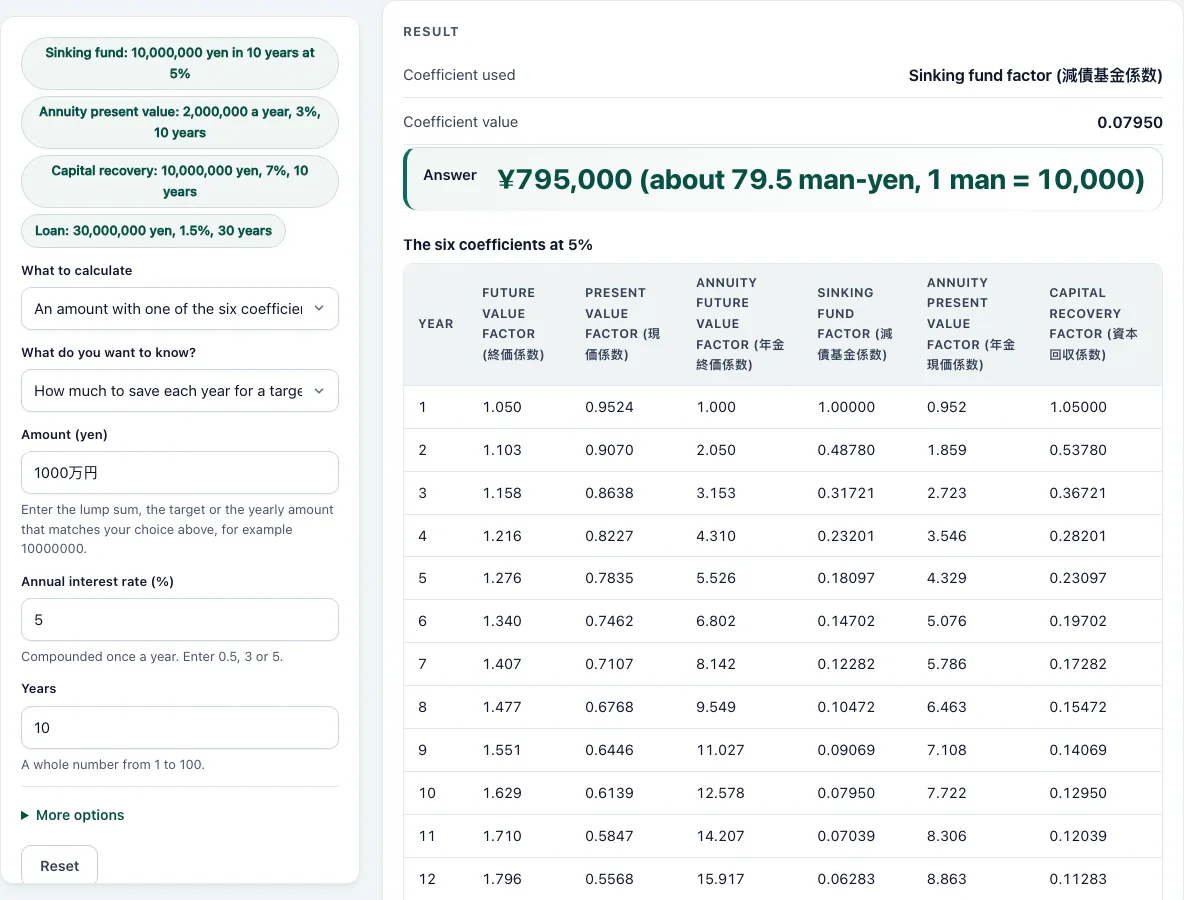
- At 5% for 10 years the sinking fund factor is 0.07950, so saving 10,000,000 yen needs about 795,000 yen a year.
- Saving 10,000,000 yen is 795,000 yen a year with the table value and 795,046 yen with the unrounded factor.
- For 30,000,000 yen at 1.5% over 30 years, equal principal repays 504,168 yen less in total than equal payment.
Sources: JAFP coefficient tables (checked 2026-10-24) · Flat 35 repayment examples (checked 2026-10-24)
How to use the six coefficients calculator
- In What to calculate, keep “An amount with one of the six coefficients”.
- In What do you want to know?, choose the question, for example “How much to save each year for a target? (sinking fund factor)”.
- Enter the Amount in yen: a lump sum, a target or a yearly amount, matching the question. Write 10000000 for ten million yen.
- Enter the Annual interest rate and the Years (a whole number from 1 to 100).
- Under More options, choose whether the coefficient uses the decimals printed in the JAFP table or is not rounded.
- Read the coefficient and the answer, then open How it was calculated to see the formula with your numbers. The table below the answer lists all six coefficients for the same rate by year.
- To compare loans instead, set What to calculate to the equal payment and equal principal comparison and enter the loan amount, the rate and the term in years. Payments are monthly and bonus payments are not included.
- Use the example buttons above the form to load a typical exam question, a pension withdrawal, a capital recovery case or the 30,000,000 yen loan.
- Copy link keeps your inputs in the address so the same calculation can be reopened or shared.
What are the six coefficients?
They come in three pairs, and the two coefficients in a pair are reciprocals of each other. With r the annual rate and n the years, compounded once a year:
| Question | Coefficient | Formula |
|---|---|---|
| What is a sum worth after n years? | Future value factor (終価係数) | (1+r)^n |
| What do I need today for a target? | Present value factor (現価係数) | 1 / (1+r)^n |
| What do yearly savings add up to? | Annuity future value factor (年金終価係数) | ((1+r)^n − 1) / r |
| How much to save each year for a target? | Sinking fund factor (減債基金係数) | r / ((1+r)^n − 1) |
| What do I need today to withdraw a fixed sum each year? | Annuity present value factor (年金現価係数) | (1 − (1+r)^−n) / r |
| What can I withdraw each year from a sum? | Capital recovery factor (資本回収係数) | r / (1 − (1+r)^−n) |
The annuity formulas assume the deposit or withdrawal happens at the end of each year. The capital recovery factor equals the sinking fund factor plus r.
Worked example in the style of the exam
You want 10,000,000 yen in 10 years and the rate is 5% a year. The sinking fund factor is r / ((1+r)^n − 1) = 0.05 / (1.05^10 − 1), which the JAFP table prints as 0.07950. Multiplying: 10,000,000 × 0.07950 = 795,000 yen to save each year. With the unrounded factor the answer is 795,046 yen. Exams use the table value, so the printed 795,000 is the expected answer.
Two more from the JAFP examples: 2,000,000 yen withdrawn each year for 10 years at 3% needs 2,000,000 × 8.530 = 17,060,000 yen today (annuity present value), and 10,000,000 yen drawn down evenly over 10 years at 7% pays 10,000,000 × 0.14238 = 1,423,800 yen a year (capital recovery).
Why the table decimals matter
The JAFP tables print the future value factor with 3 decimals, the present value factor with 4, the annuity future value factor with 3, the sinking fund factor with 5, the annuity present value factor with 3 and the capital recovery factor with 5. Rounding the factor changes the answer slightly, which is why the calculator shows both. The tool’s 1,040 table checks come from recomputing every printed value in the six tables: 1,039 match, and one printed 資本回収係数 (11 years, 1%) has transposed digits.
Equal payment against equal principal
With equal payment (元利均等) the monthly payment is constant: loan × the capital recovery factor for the monthly rate and the number of payments. With equal principal (元金均等) the principal repaid is constant and the payment falls as interest shrinks. For 30,000,000 yen at 1.5% over 30 years the totals are 37,272,768 yen (equal payment, 103,536 yen a month) and 36,768,600 yen (equal principal, first payment 120,833 yen), a difference of 504,168 yen. For 20,000,000 yen the difference is 336,058 yen. Both figures match the examples published by Flat 35. Banks round differently, so check your lender’s repayment table for the real figures.
Frequently asked questions
Does the calculator match the exam answers?
It matches the printed JAFP coefficient tables, and the default setting multiplies by the table value as the exams do. Use the unrounded option to see the exact figure.
Are the deposits and withdrawals at the start or the end of the year?
At the end of the year. For payments at the start of the year, multiply the annuity future value or annuity present value result by (1 + r), and divide the sinking fund or capital recovery result by (1 + r).
Can I compute the six coefficients for a rate that is not in the table?
Yes. The tables list 1% to 10% in whole percentages; the calculator accepts any rate from 0% to 100% and any whole number of years up to 100.
Which exam levels use the six coefficients?
They appear in life planning and financial planning questions of the FP exams (levels 3 and 2 in particular). Check the exam provider for the current syllabus and which tables are printed in the question paper.
What happens at 0% interest?
The future and present value factors are 1, the annuity factors equal the number of years, and the sinking fund and capital recovery factors equal 1 divided by the years.
Does the loan comparison include bonus payments or a variable rate?
No. It assumes monthly payments at a fixed rate and no fees, insurance or tax relief.
- TVMStack home — all the calculators on this site
- About the tools — how results are computed and tested
- Japanese version (日本語) — the same calculator with Japanese labels and yen formatting
- TVM Calculator — solve N, I/Y, PV, PMT or FV for any payment schedule; the six coefficients are the special case of yearly payments and yearly compounding
- Sinking Fund Calculator — the deposit that reaches a target, the sinking fund coefficient (減債基金係数)
- Annuity Calculator — present value, future value or payment of level payments
- Present Value Calculator — what a future amount is worth today
- Loan Amortization Calculator — level payment and the full repayment schedule
- The TVMStack app — adds cash flows, NPV and IRR (planned)