Future Value Calculator
Enter what you have, what you add each period, the rate and the years, and see what it grows to.
Free · runs in your browser · nothing is uploaded
Recent
Your last 10 settings, saved only in this browser. Nothing is uploaded.
A future value calculator shows what money will be worth later when it earns compound interest. Enter a starting amount, a regular deposit, the yearly rate and the number of years, and it returns the future value, how much of it is your own money and how much is interest.
It handles a lump sum, regular deposits or both together, and deposits at the start or the end of each period. Under the answer it writes out the equation with your numbers, and a table shows the balance at the end of every year, so you can see when interest starts to outweigh deposits. It runs in your browser and does not store what you enter.
How to use the Future Value Calculator
- Enter the Starting amount you already have. Use 0 if you start from nothing.
- Enter the Deposit each period: the amount you add every month, quarter or year. Use 0 to grow a lump sum only.
- Enter the Annual interest rate as a percentage, for example 6.
- Enter the Years the money stays invested.
- Set Deposits and compounding per year: 12 for monthly, 4 for quarterly, 1 for yearly. Interest is compounded at the same frequency as the deposits.
- Tick Deposits at the start of each period if you pay in at the start of the month or year rather than the end.
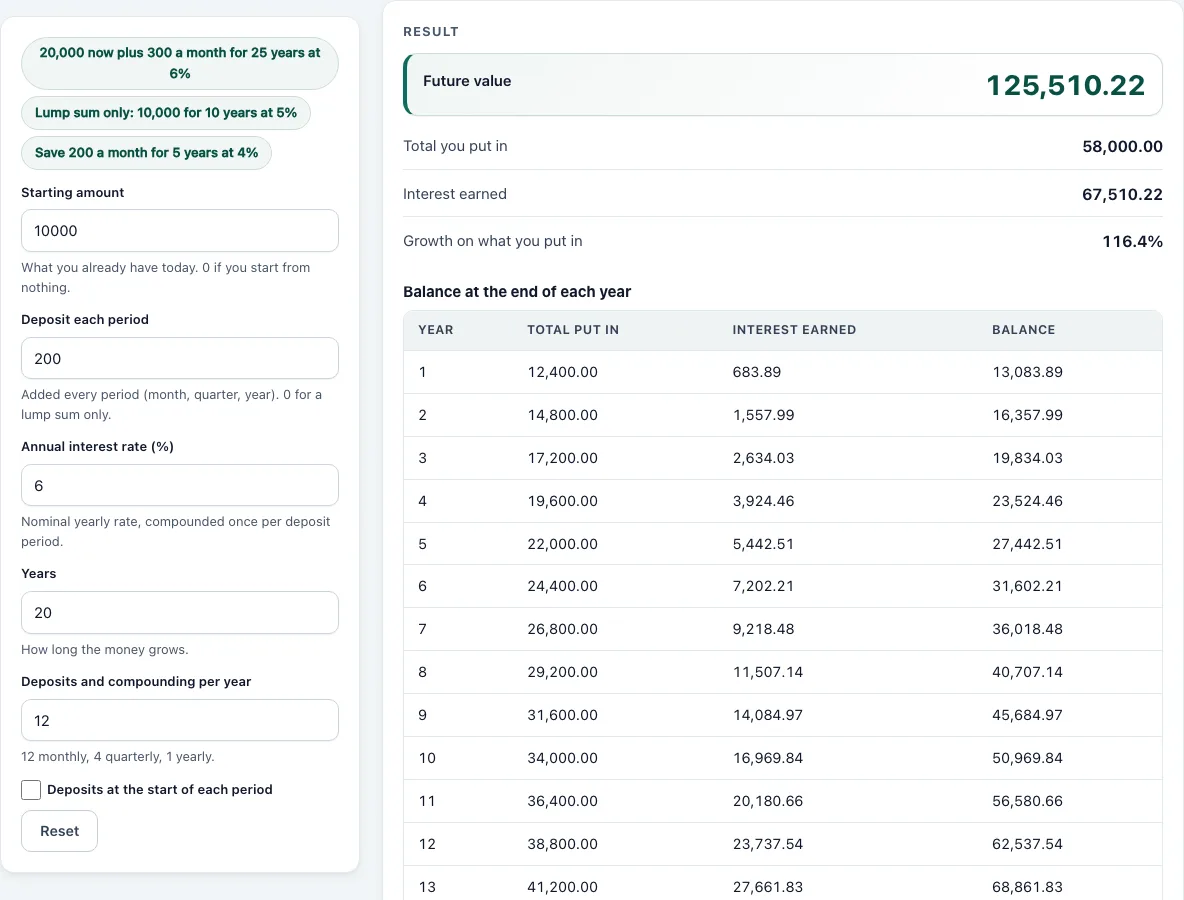
- Read the Future value, then open How it was calculated for the equation with your numbers. The table lists the balance after each year.
The example buttons load a retirement plan, a lump sum on its own and a five-year savings plan.
Change one input at a time to see its effect. Raising the deposit by 50 a month, or adding five years, usually moves the result far more than a change of one percentage point in the rate, and the table shows where the gap opens up.
If you add deposits only at certain times, such as once a year, set deposits per year to 1 and enter the yearly amount. Interest then compounds once a year too.
Future value formula
With a starting amount PV, a deposit PMT each period, a rate i per period and N periods, the future value is:
FV = PV·(1+i)^N + PMT·((1+i)^N − 1) ÷ i
For deposits at the start of each period the deposit part is multiplied by (1+i). The rate per period is the annual rate divided by the number of periods a year, so 6% paid monthly is 0.5% per month.
Worked examples
| Starting amount | Deposit | Rate | Years | Per year | Future value |
|---|---|---|---|---|---|
| 10,000 | 200 | 6% | 20 | 12 | 125,510.22 |
| 0 | 200 | 4% | 5 | 12 | 13,259.80 |
| 10,000 | 0 | 5% | 10 | 1 | 16,288.95 |
| 20,000 | 300 | 6% | 25 | 12 | 297,197.58 |
In the first row you put in 10,000 + 200 × 240 = 58,000 and interest adds 67,510.22. Interest is a larger share of the result the longer the money stays invested.
Why more years matter more than a higher rate
Compound interest grows the balance by a fixed percentage of an amount that keeps getting bigger, so each extra year adds more than the one before. In the 25-year example above, interest (187,197.58) is more than the 110,000 you put in.
Common mistakes when estimating future value
- Using the nominal rate for a different compounding period. The calculator compounds at the same frequency as the deposits. If your account compounds daily but you deposit monthly, the true result is slightly higher.
- Forgetting that rates change. A fixed 6% for 25 years is an assumption. Run the calculator at a lower and a higher rate to see a range.
- Ignoring fees and tax. Fund fees of 1% a year take a big share of a 25-year result. Subtract them from the rate before you enter it.
- Counting inflation. The future amount is in future money. At 2.5% inflation, 297,197.58 in 25 years buys what about 160,000 buys today.
Future value and the other time-value tools
Future value is one of five linked quantities: present value, payment, rate, number of periods and future value. If you know the target and want the deposit, use the sinking fund calculator. If you know everything except the rate or the time, use the TVM calculator.
Frequently asked questions
What is the difference between future value and compound interest?
Compound interest is the interest earned. Future value is the whole balance at the end: what you put in plus the interest.
Does the calculator include inflation or taxes?
No. The result is in the same money as the inputs. To see what it buys in today’s money, use a lower rate (the rate minus inflation) as an approximation.
How do I find the deposit needed to reach a target?
Use the sinking fund calculator, which solves for the deposit instead of the future value.
Why is my bank’s figure a little different?
Banks may compound daily, credit interest only at month end or round each month. Match the compounding frequency in this calculator to your account for a closer result.
How much do I need to save each month to reach a goal?
Use the sinking fund calculator: enter the goal, the rate and the years, and it returns the monthly deposit.
Does the order of deposits matter?
Only within a period. Depositing at the start of each period earns one extra period of interest on every deposit, which the checkbox models.
Why is my result lower than a spreadsheet’s FV function?
Spreadsheets use negative numbers for money paid in. Here you enter positive amounts and the result is positive. The numbers agree when the signs are set accordingly.
Can I enter a negative starting amount?
No. The calculator assumes you start with zero or a positive balance.
- TVM Calculator: solve any one of N, I/Y, PV, PMT or FV
- Present Value Calculator: what a future amount is worth today
- Annuity Calculator: value or payment of level and growing payments
- Perpetuity Calculator: value of payments that never end
- Sinking Fund Calculator: the deposit that reaches a target
- Lease Payment Calculator: monthly lease payment and its two parts
- Balloon Payment Calculator: the lump sum due at the end of a loan
- The TVMStack app: the planned app that adds cash flows, NPV and IRR
- About the tools: how the results are computed and tested