Effective Annual Rate Calculator
Enter a nominal rate and how often it compounds to see the rate you really earn or pay in a year.
Free · runs in your browser · nothing is uploaded
Recent
Your last 10 settings, saved only in this browser. Nothing is uploaded.
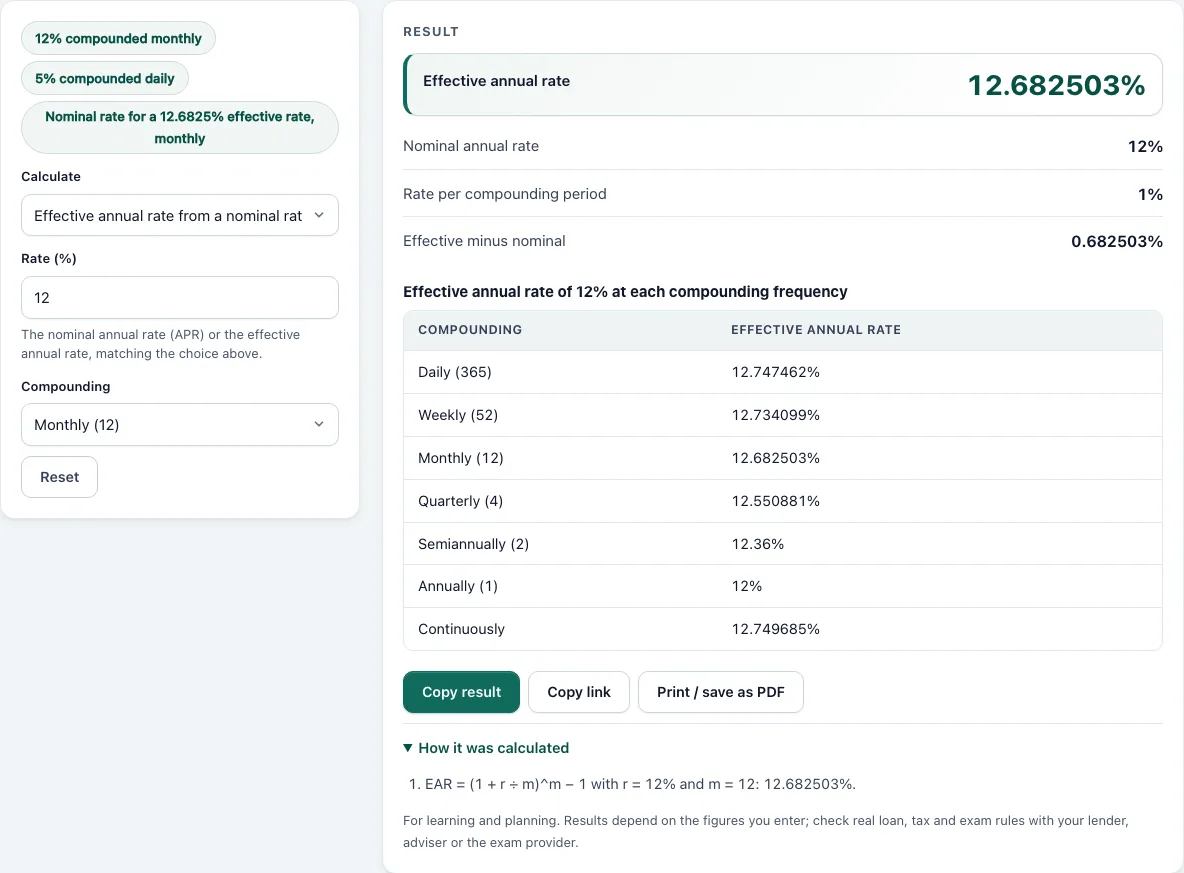
An effective annual rate calculator shows the interest you actually earn or pay over a year once compounding is counted, the EAR. A nominal rate of 12% compounded monthly is not 12% a year: each month’s interest earns interest, so the effective rate is 12.682503%.
This effective annual rate calculator converts in both directions. Enter a nominal rate and a compounding frequency to get the EAR, or enter an EAR to find the nominal rate that produces it. A table shows the same rate at every common frequency, from yearly to daily and continuous, so you can compare offers that compound differently.
How to use the Effective Annual Rate Calculator
- In Calculate, choose whether to find the effective annual rate from a nominal rate, or the nominal rate from an effective rate.
- Enter the Rate (%). This is the nominal annual rate for the first choice and the effective annual rate for the second.
- Choose the Compounding frequency: daily, weekly, monthly, quarterly, semiannually, annually or continuously.
- Read the Effective annual rate, the Nominal annual rate and the Rate per compounding period.
- The last result row shows how much higher the effective rate is than the nominal rate.
- Open How it was calculated to see the formula with your numbers. The table underneath repeats the calculation at every frequency.
The example buttons load a credit card rate, a daily-compounded savings rate and the reverse calculation.
To compare two offers, enter each one with its own compounding frequency and compare the effective annual rates; the higher is better for savings and worse for borrowing.
If you only know a monthly or daily rate, multiply it by 12 or 365 to get the nominal annual rate before you enter it, or work from the effective rate in the other mode.
Both modes use the same frequency list, so you can convert a nominal rate to an effective one and then check the result by converting it back.
Effective annual rate formula
For a nominal annual rate r compounded m times a year:
EAR = (1 + r ÷ m)^m − 1
For continuous compounding, EAR = e^r − 1. To go the other way, r = m·((1 + EAR)^(1/m) − 1), or r = ln(1 + EAR) for continuous compounding.
Worked examples
| Nominal rate | Compounding | Effective annual rate |
|---|---|---|
| 12% | monthly | 12.682503% |
| 5% | daily | 5.12675% |
| 5% | continuous | 5.12711% |
Going back, an effective rate of 12.6825% with monthly compounding corresponds to a nominal rate of about 12% (11.999997%, because 12.6825 is rounded).
EAR, APR and APY
The effective annual rate is what savings accounts call the annual percentage yield (APY). The APR on a loan is usually the nominal rate with fees included. Use the EAR to compare products that compound at different frequencies. To include fees in a loan rate, use the APR calculator.
Why EAR matters when comparing offers
Two accounts can both quote 5% and still pay differently. If one compounds yearly and the other daily, the first has an effective rate of 5% and the second 5.12675%. On a loan the same difference works against you. Comparing effective rates removes the effect of the compounding frequency.
- Savings: the effective rate is often shown as APY.
- Credit cards: a stated 24% compounded daily costs about 27.1% a year.
- Bonds and loans: fees are not included; for those use the APR calculator.
How much does compounding matter?
At low rates, little: 3% compounded monthly is 3.0416%. At high rates it matters more: 36% compounded monthly is 42.58%. The gap grows with the rate and with the number of compounding periods, but flattens out; going from daily to continuous at 5% adds only 0.00036 percentage points.
Converting a monthly rate
A monthly rate of 1% is a nominal annual rate of 12% compounded monthly, so the effective annual rate is 12.682503%, not 12%. Enter 12 and choose monthly to check.
Worked comparison of two savings offers
Bank A pays 4.95% compounded daily and bank B pays 5.00% compounded yearly. The effective rate of A is (1 + 0.0495 ÷ 365)^365 − 1, about 5.07%, and B pays exactly 5%. The lower headline rate is the better deal because it compounds more often. Enter each offer with its own frequency to check it.
The continuous limit
As the compounding frequency grows, the effective rate approaches e^r − 1. The table row for continuous compounding shows this limit, so you can see how little is left to gain beyond daily compounding. For a loan, the same limit shows the most that a lender can charge for a given nominal rate.
Practical uses
- Compare the real yield of savings accounts, certificates of deposit and money market funds.
- Check what a credit card or store account charges after compounding.
- Convert between a monthly interest rate quoted by a lender and a yearly figure for budgeting.
- Check textbook and exam answers, since many finance courses use effective rates.
Frequently asked questions
Why is the effective rate higher than the nominal rate?
Because interest from earlier periods earns interest itself within the year. The more often it compounds, the larger the gap.
What is the maximum effective rate for a given nominal rate?
Continuous compounding. For 5% it is 5.12711%, only slightly above daily compounding at 5.12675%.
Is EAR the same as APY?
For savings, yes: the annual percentage yield is the effective annual rate. For loans, the APR is a different measure that includes fees.
Can I use it for monthly rates?
Convert a monthly rate to a nominal annual rate by multiplying by 12, then choose monthly compounding. Or enter the periodic rate × 12 directly.
Is the nominal rate the same as APR?
For a loan without fees, yes: the APR is the nominal annual rate. With fees it is higher.
Can I enter a rate with several decimals?
Yes. Enter it as 12.6825 and the calculator uses the full number.
Why do banks quote the nominal rate?
It looks lower on loans and is simpler to quote. Rules in many countries require the effective rate (APY for savings, APR for loans) to be shown as well.
What does the gap row show?
It is the effective annual rate minus the nominal rate, in percentage points: the extra yearly interest that comes only from compounding.
- TVM Calculator: solve any one of N, I/Y, PV, PMT or FV
- Future Value Calculator: what a sum and regular deposits grow to
- Present Value Calculator: what a future amount is worth today
- Annuity Calculator: value or payment of level and growing payments
- Perpetuity Calculator: value of payments that never end
- APR Calculator: the true yearly cost of a loan with fees
- Lease Payment Calculator: monthly lease payment and its two parts
- The TVMStack app: the planned app that adds cash flows, NPV and IRR
- About the tools: how the results are computed and tested