Depreciation Calculator
Enter the cost, salvage value and life to get the depreciation schedule for each year.
Free · runs in your browser · nothing is uploaded
Recent
Your last 10 settings, saved only in this browser. Nothing is uploaded.
Depreciation spreads the cost of an asset over its useful life. This depreciation calculator produces the yearly schedule for the three standard methods: straight line, sum-of-the-years’ digits and declining balance (including double declining balance), including the straight line (SL) case that many searches ask for.
Enter the cost, the salvage value you expect at the end and the useful life in years. The calculator lists the depreciation, the accumulated depreciation and the book value for every year, and handles a first year that is only part of a full year. Declining balance never takes the book value below salvage, with an option to switch to straight line when that gives more.
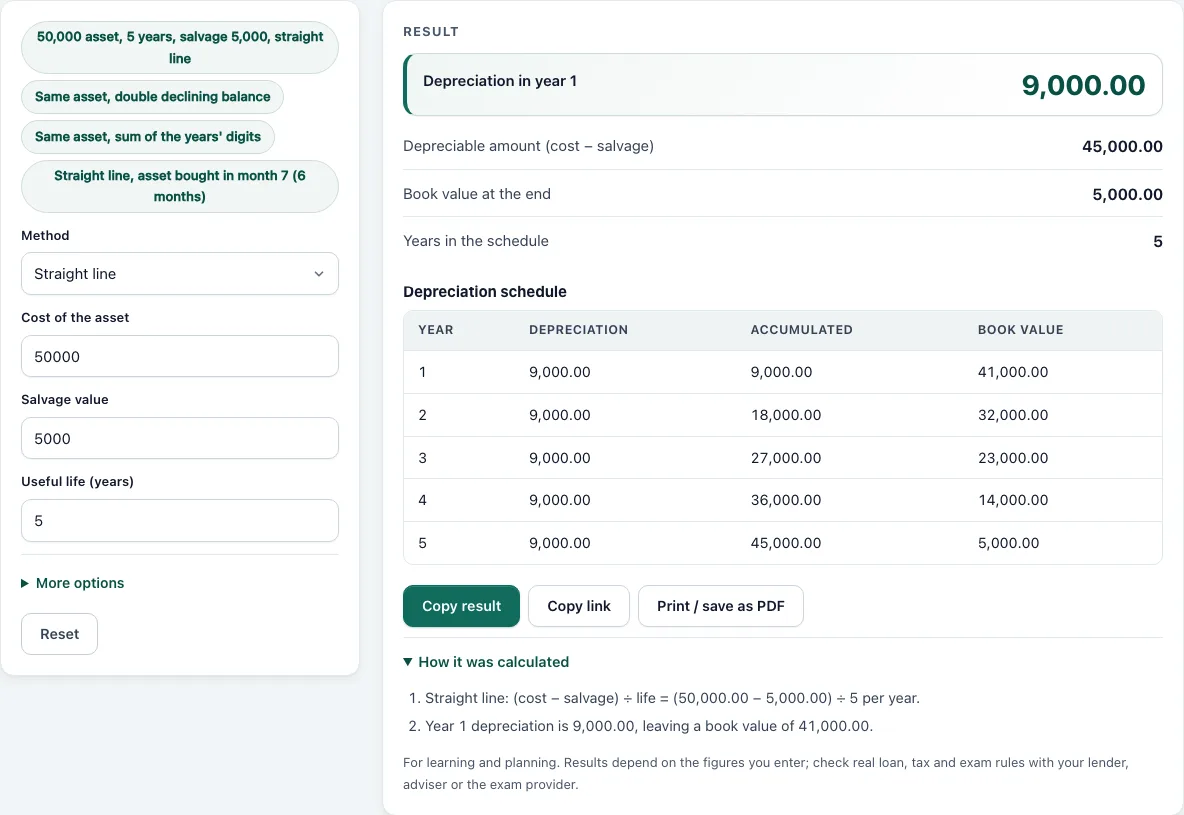
How to use the Depreciation Calculator
- Choose the Method: straight line, sum of the years’ digits or declining balance.
- Enter the Cost of the asset.
- Enter the Salvage value: what the asset is expected to be worth at the end. Use 0 if none.
- Enter the Useful life (years) as a whole number.
- For declining balance, enter the Declining balance factor: 2 for double declining balance, 1.5 for 150%.
- Under More options, set the Months in the first year if the asset enters service part-way through the year; the schedule then runs one year longer. For declining balance you can tick Switch to straight line when it gives more.
- Read the Depreciation in year 1, the Depreciable amount and the Book value at the end. The table lists every year.
The example buttons load the same 50,000 asset under each method, and a straight line schedule for an asset bought in month 7.
To compare methods, run the same cost, salvage and life under each method and look at the accumulated depreciation after the first two or three years: that is where they differ most.
The life must be a whole number of years. If your asset is depreciated in months, convert the schedule to a yearly one first, or use the months field only for the first year.
The three methods
- Straight line: (cost − salvage) ÷ life every year.
- Sum-of-the-years’ digits: year k takes (life − k + 1) ÷ (sum of 1…life) of the depreciable amount, so the charge falls steadily.
- Declining balance: each year’s charge is the opening book value times factor ÷ life, never taking the book value below salvage.
Worked example: a 50,000 asset, salvage 5,000, 5 years
| Year | Straight line | Sum of the years’ digits | Double declining balance |
|---|---|---|---|
| 1 | 9,000 | 15,000 | 20,000 |
| 2 | 9,000 | 12,000 | 12,000 |
| 3 | 9,000 | 9,000 | 7,200 |
| 4 | 9,000 | 6,000 | 4,320 |
| 5 | 9,000 | 3,000 | 1,480 |
All three total 45,000. Declining balance in year 5 is limited to 1,480 so the book value stops at the 5,000 salvage value. With a first year of 6 months, straight line gives 4,500 in the first and last years and 9,000 in between over six years.
Choosing the right method
Straight line is the simplest and the usual choice for financial reports. Accelerated methods take more of the cost early, which suits assets that lose value or usefulness quickly. Tax rules in your country may require a specific method and rate table, so follow them for tax returns.
- Straight line matches an asset that gives the same benefit each year, such as a building or office furniture.
- Sum-of-the-years’ digits and declining balance match assets that lose value or are used heavily early on, such as vehicles and computers.
- Units of production is a different method that depreciates by usage rather than time and is not included here.
Effects on accounts
All three methods write off the same total, the cost less the salvage value, over the life. They differ only in timing: accelerated methods give higher expenses and lower profit early, and lower expenses later. The book value at the end of each year is the cost less the accumulated depreciation.
Switching to straight line
With declining balance, the charge falls each year and the book value only approaches salvage. Many companies switch to straight line in the year when it would give a larger charge, so the asset reaches salvage exactly on schedule. The checkbox applies this rule. In the example above the final charge is capped at 1,480 by the salvage floor in either case.
Tax versus accounting
Tax authorities set their own methods, lives and rates, such as MACRS in the United States or the 200% declining balance table used in Japan. The figures here follow the textbook methods and are suited to management accounts, planning and learning.
Frequently asked questions
What is salvage value?
The amount the asset is expected to be worth at the end of its useful life. Depreciation covers the cost minus this amount.
What is double declining balance?
Declining balance with a factor of 2: each year’s charge is twice the straight-line rate applied to the remaining book value.
Does the calculator follow tax depreciation tables?
No. Tax systems such as MACRS use their own tables and conventions. This calculator follows the textbook methods.
What happens with a partial first year?
The first year is prorated by the months you enter and the remainder is added after the last full year, so the schedule is one year longer.
Can I depreciate land?
Land is generally not depreciated. Enter only the cost of depreciable parts, such as buildings and equipment.
What life should I use?
Use the useful life from your accounting policy or tax rules. If unsure, ask your accountant.
Can the book value fall below salvage?
No. In every method the charge is capped so the book value stops at the salvage value, even if the formula would depreciate further.
Does the first year always have 12 months?
By default yes. Enter fewer months under More options if the asset enters service part-way through the first year.
- MIRR Calculator: return that avoids the multiple-IRR problem
- XIRR Calculator: annual return of cash flows on specific dates
- CAGR Calculator: the steady growth rate between two values
- Rule of 72 Calculator: years to double, by the rule and exactly
- Bond Price Calculator: clean and dirty price from the yield
- Annuity Calculator: value or payment of level and growing payments
- Perpetuity Calculator: value of payments that never end
- The TVMStack app: the planned app that adds cash flows, NPV and IRR
- About the tools: how the results are computed and tested