Bond Price Calculator
Enter the dates, coupon and yield to get the bond price per 100 and for your holding.
Free · runs in your browser · nothing is uploaded
Recent
Your last 10 settings, saved only in this browser. Nothing is uploaded.
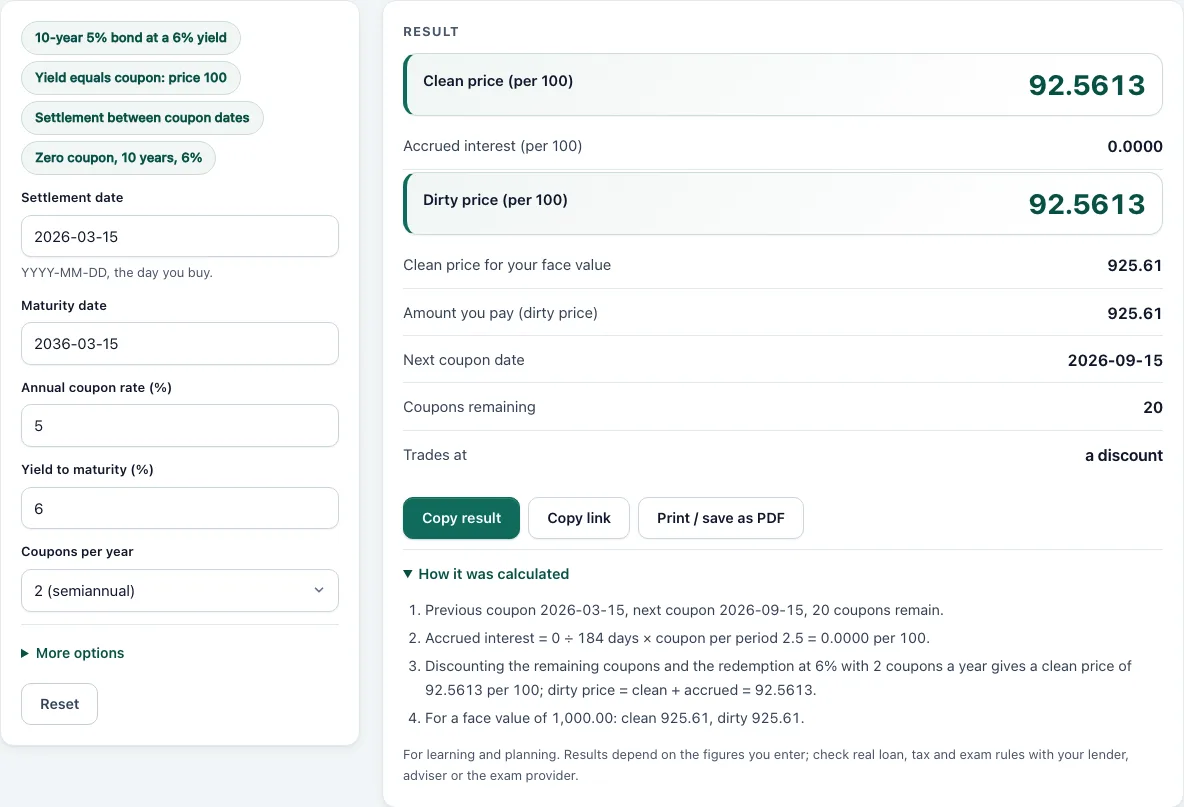
A bond price is the present value of its remaining coupons and its redemption, discounted at the yield you require. This bond price calculator takes the settlement date, the maturity date, the coupon, the yield and the coupon frequency, and returns the clean price, the accrued interest and the dirty price.
The clean price is the quoted price. The dirty price, which is clean plus accrued interest since the last coupon, is what you actually pay. Both are shown per 100 of redemption value and in money for your face value, together with the next coupon date, the number of coupons left and whether the bond trades at a premium or a discount. Day count can be actual/actual or 30/360.
How to use the Bond Price Calculator
- Enter the Settlement date, the day you buy, as YYYY-MM-DD.
- Enter the Maturity date.
- Enter the Annual coupon rate as a percentage, and the Yield to maturity you require.
- Choose how many Coupons per year the bond pays: usually 2, sometimes 1.
- Under More options, enter the Face value of your holding to see the price in money, the Redemption value per 100 if it is not 100, and the Day count convention.
- Read the Clean price (per 100), the Accrued interest and the Dirty price. The Trades at row says premium, discount or par.
- Open How it was calculated for the coupon period, the accrued interest and the price with your numbers.
The example buttons load a 10-year 5% bond at 6%, a bond priced at par, settlement between coupon dates and a zero-coupon bond.
To see how a price reacts to the market, enter the same bond at yields 1 point apart. A longer-dated bond changes price more for the same yield change.
Dates must be real calendar dates, and the settlement date must be before the maturity date. Month-end maturities, such as the last day of February, follow the usual end-of-month rule when coupon dates are counted back.
Bond price formula
When the settlement date is a coupon date, the price is the sum of the discounted coupons and redemption:
Price = Σ (C ÷ f) ÷ (1 + y ÷ f)^k + R ÷ (1 + y ÷ f)^N
where C is the annual coupon, f the coupons per year, y the yield, R the redemption and N the number of coupons left. Between coupon dates the cash flows are discounted by the fraction of the period remaining, and the accrued interest is subtracted from the full price to give the clean price.
Worked examples
| Bond | Settlement | Yield | Clean | Dirty |
|---|---|---|---|---|
| 5% coupon, matures 2036-03-15, semiannual | 2026-03-15 | 6% | 92.5613 | 92.5613 |
| same | 2026-06-20 | 6% | 92.6970 | 94.0149 |
| same, yield = coupon | 2026-03-15 | 5% | 100.0000 | 100.0000 |
| zero coupon, annual | 2026-03-15 | 6% | 55.8395 | 55.8395 |
For a face value of 1,000 the first bond costs 925.61. In the second row, 1.3179 of accrued interest is added to the clean price.
Why bond prices fall when yields rise
The coupons are fixed, so a higher required yield means a lower price. A bond whose coupon is below the market yield sells at a discount and one above it at a premium. The price moves toward 100 as maturity approaches.
Reading the result
- Clean price is what is quoted in markets and shown in most data services. It is expressed per 100 of redemption value.
- Accrued interest is the part of the next coupon that the seller has earned. A buyer pays it on top of the clean price and gets it back with the next coupon.
- Dirty price is the clean price plus accrued interest. It is the cash you pay.
- Premium or discount. A bond trades at a premium when its price is above the redemption value, which happens when its coupon is above the market yield.
Settlement dates and coupon periods
The coupon dates are counted back from the maturity date in steps of 12 divided by the coupon frequency in months. The previous and next coupon dates are shown in the steps, with the days accrued and the days in the period. A date that falls on a coupon date has no accrued interest.
Limits
The calculator prices a bond with fixed coupons and a single redemption. It does not handle call or put features, floating coupons, inflation linking or odd first coupons. For bonds on a yield basis that follows another convention, such as US Treasury bills, check the exact convention before relying on the figure. The result is before tax and fees.
Frequently asked questions
What is the difference between clean and dirty price?
The clean price excludes interest accrued since the last coupon; the dirty price includes it and is the amount the buyer pays.
Which day count should I use?
Actual/actual for most government bonds, 30/360 for many corporate and municipal bonds. Check the bond’s terms.
Can I use this for a zero-coupon bond?
Yes. Enter a coupon of 0 and the price is the discounted redemption value.
How do I find the yield from a price?
Use the yield to maturity calculator, which solves the same equation for the yield.
What is the duration of the bond?
Duration is not calculated here; it measures how sensitive the price is to the yield. Compare prices at two yields to estimate it.
Why does the price change a little with the day count?
Actual/actual counts real days in the coupon period, 30/360 assumes 30-day months. The accrued interest and therefore the price differ slightly.
What coupon frequency does a typical bond use?
US corporate and Treasury bonds usually pay semiannually, many European bonds pay annually, and some floating-rate notes pay quarterly.
What if my bond redeems above 100?
Enter the redemption value per 100 under More options, and the coupon is still a percentage of face value.
- MIRR Calculator: return that avoids the multiple-IRR problem
- XIRR Calculator: annual return of cash flows on specific dates
- CAGR Calculator: the steady growth rate between two values
- Rule of 72 Calculator: years to double, by the rule and exactly
- Yield to Maturity Calculator: the yield implied by a bond price
- Loan Amortization Calculator: payment and full repayment schedule
- APR Calculator: the true yearly cost of a loan with fees
- The TVMStack app: the planned app that adds cash flows, NPV and IRR
- About the tools: how the results are computed and tested