Balloon Payment Calculator
Find the lump sum due at the end of a balloon loan, or the payment that leaves the balloon you want.
Free · runs in your browser · nothing is uploaded
Recent
Your last 10 settings, saved only in this browser. Nothing is uploaded.
A balloon payment calculator is for loans with regular payments that do not repay the whole loan, so a large final payment, the balloon, is due at the end. The payments are often calculated as if the loan ran for 30 years but the balloon falls due after 5 or 7.
This balloon payment calculator works in two directions. Enter the loan, the rate, the years until the balloon and the amortization period, and it returns the payment and the balloon owed. Or enter the balloon you want and it returns the payment that leaves it. It also shows the total interest and what share of the loan the balloon represents, with the equations worked out for your numbers.
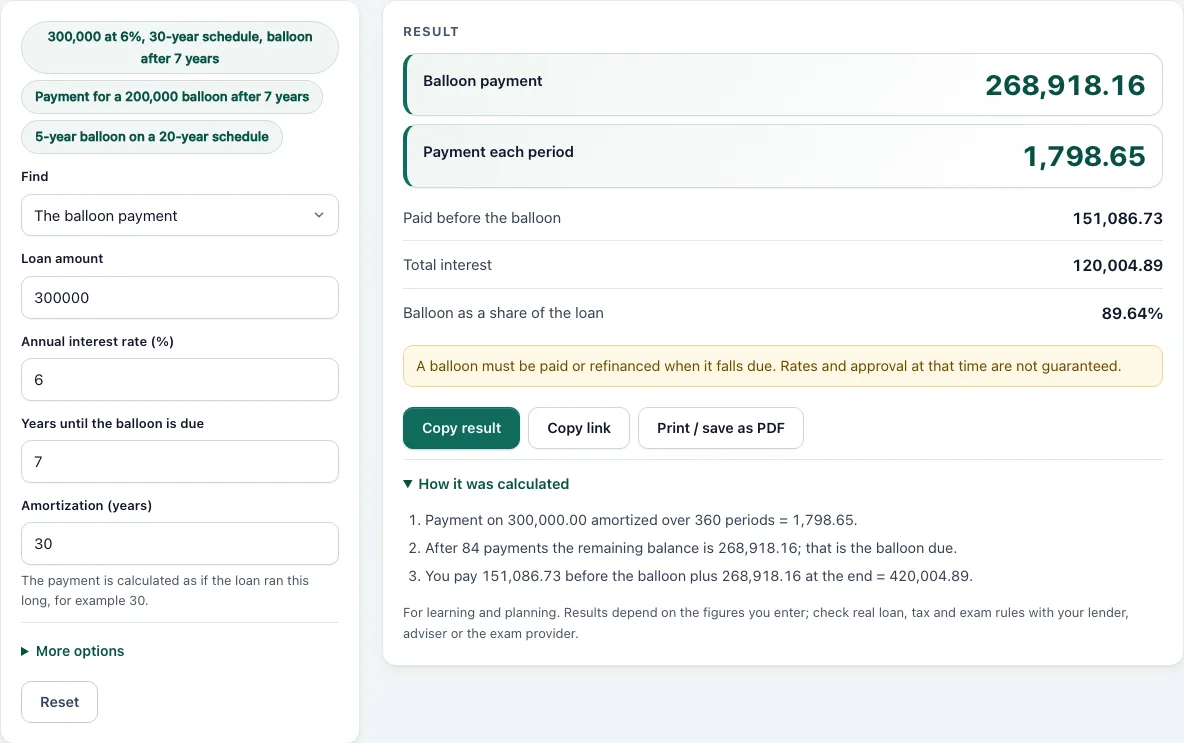
How to use the Balloon Payment Calculator
- In Find, choose The balloon payment or The payment for a chosen balloon.
- Enter the Loan amount.
- Enter the Annual interest rate.
- Enter the Years until the balloon is due, for example 7.
- If you are finding the balloon, enter the Amortization (years): the payment is calculated as if the loan ran that long, for example 30. If you are finding the payment, enter the Balloon payment you want to owe.
- Under More options, change Payments per year if not monthly.
- Read the Balloon payment and the Payment each period, then the total paid before the balloon, the total interest and the balloon as a share of the loan.
- Open How it was calculated for each equation with your numbers.
The example buttons load a 7-year balloon on a 30-year schedule, the payment for a 200,000 balloon and a 5-year balloon on a 20-year schedule.
Try a few amortization periods and balloon dates: the longer the schedule behind the payment, the smaller the payment and the larger the balloon.
If the balloon looks too large, shorten the amortization period or lengthen the term before the balloon falls due, and compare the payment: the calculator updates as soon as you change a field.
Balloon payment formula
The payment is the usual level payment for the amortization period, Payment = P·i ÷ (1 − (1+i)^−Na). The balloon is the balance left after n payments:
Balloon = P·(1+i)^n − Payment·((1+i)^n − 1) ÷ i
To find the payment for a chosen balloon B, solve the same equation for the payment: Payment = (P·(1+i)^n − B) ÷ (((1+i)^n − 1) ÷ i).
Worked examples
| Loan | Rate | Balloon after | Schedule | Payment | Balloon |
|---|---|---|---|---|---|
| 300,000 | 6% | 7 years | 30 years | 1,798.65 | 268,918.16 |
| 300,000 | 6% | 7 years | balloon chosen: 200,000 | 2,460.86 | 200,000.00 |
| 300,000 | 6% | 5 years | 20 years | 2,149.29 | 254,698.80 |
In the first row you pay 151,086.73 over seven years and still owe 268,918.16, almost 90% of the loan, because the early payments are mostly interest.
Risks of a balloon loan
The balloon must be paid in cash or refinanced when it falls due. If rates are higher or your credit has changed, a refinance may cost more or may not be available. Treat the calculator’s balloon as the amount you will need to find, and plan for it.
When balloon loans are used
Balloon loans are common in commercial real estate, where a 5 or 10-year loan is priced on a 25 or 30-year schedule, and in some car and equipment finance. The borrower expects to sell the asset or refinance before the balloon is due.
- Lower payments now. The payment in the first example, 1,798.65, is the same as a 30-year loan, even though the loan is only for 7 years.
- A large final payment. The balloon of 268,918.16 is 89.64% of the amount borrowed.
- Refinancing risk. If rates rise, property values fall or your income changes, you may not be able to refinance on good terms.
Interest-only and balloon loans
An interest-only loan is the extreme case: payments cover only interest, so the whole principal is the balloon. To model it, choose “payment for a chosen balloon” and enter the full loan amount as the balloon minus a small amount, or compare with the loan amortization calculator to see how a standard loan reduces the balance.
Planning for the balloon
Start a savings plan early with the sinking fund calculator so that the deposit builds toward the balloon, or plan a sale before the due date. Confirm in the loan contract whether the lender is obliged to offer a refinance.
Frequently asked questions
Why is the balloon so large after several years of payments?
With a long amortization period, most of each early payment is interest. After seven years of a 30-year schedule at 6%, the balance has only fallen by about 10%.
Is a balloon payment the same as a residual value?
Similar idea, different use: a lease’s residual is the value of the car at the end, while a balloon is debt you still owe to the lender.
Can I choose the balloon instead?
Yes. Switch Find to the payment for a chosen balloon and enter the balloon you want. A bigger balloon means a smaller payment.
What happens if I cannot pay the balloon?
You can refinance, sell the asset or ask the lender about an extension. Failing to pay can lead to default, so check the terms in your loan contract.
Why is the payment lower than a loan that ends at the same time?
Because it is calculated over a longer schedule. A 7-year fully amortizing loan would need a much larger payment.
Can the balloon be larger than the loan?
Not in this calculator, which requires a balloon smaller than the loan. With negative amortization the balance grows, which is outside its scope.
- Loan Amortization Calculator: payment and full repayment schedule
- APR Calculator: the true yearly cost of a loan with fees
- Lease Payment Calculator: monthly lease payment and its two parts
- TVM Calculator: solve any one of N, I/Y, PV, PMT or FV
- Future Value Calculator: what a sum and regular deposits grow to
- Depreciation Calculator: how an asset loses value over time
- The TVMStack app: the planned app that adds cash flows, NPV and IRR
- About the tools: how the results are computed and tested