APR Calculator
Enter the loan, the fees and the stated rate to see what the loan really costs per year.
Free · runs in your browser · nothing is uploaded
Recent
Your last 10 settings, saved only in this browser. Nothing is uploaded.
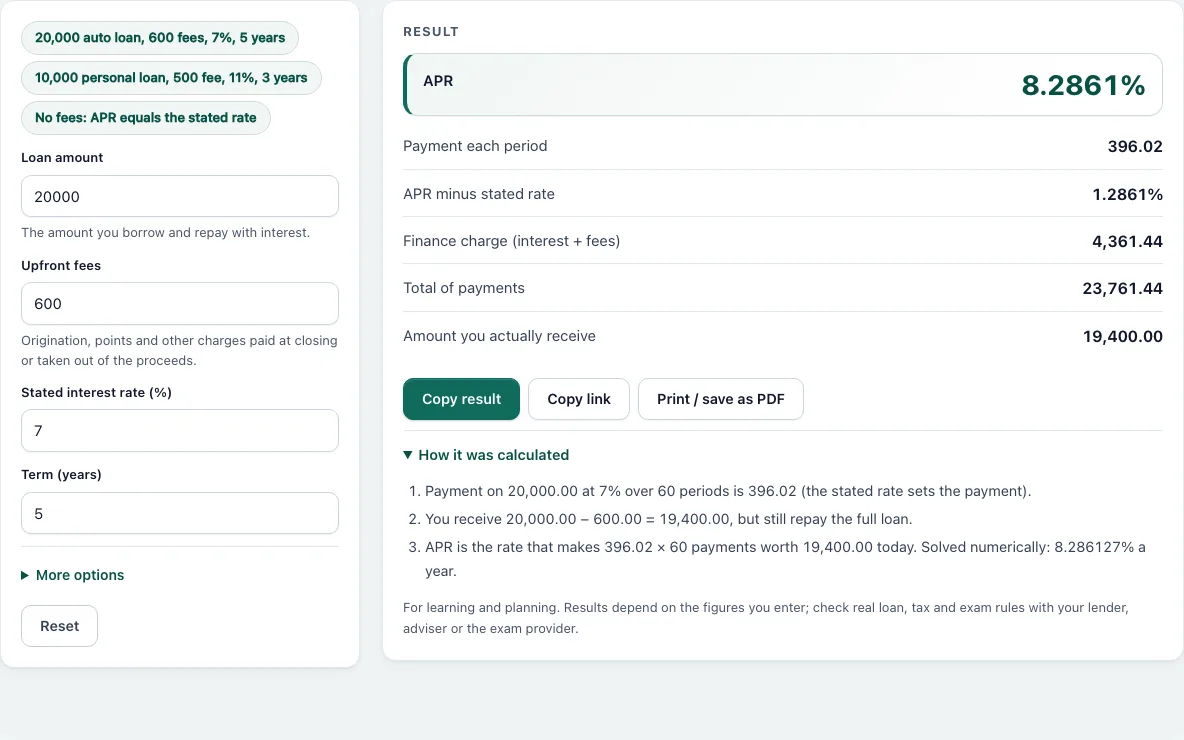
An APR calculator finds the yearly cost of a loan including its fees, not just the interest rate. If a lender takes 600 off a 20,000 loan as a fee, you receive 19,400 but still repay 20,000 with interest, so the cost per year is higher than the stated rate.
This APR calculator finds that rate. Enter the loan amount, the upfront fees, the stated interest rate and the term. It returns the APR, the payment, the gap between APR and the stated rate and the total finance charge, with the equation worked out for your loan. Use it to compare loan offers that combine different rates and fees.
How to use the APR Calculator
- Enter the Loan amount: the sum you borrow and repay.
- Enter the Upfront fees: origination fees, points and other charges that you pay at closing or that are taken out of the loan proceeds. Use 0 if there are none.
- Enter the Stated interest rate as a percentage.
- Enter the Term (years).
- Under More options, change Payments per year if you do not pay monthly.
- Read the APR, then compare it with the stated rate in the row APR minus stated rate.
- Check the Finance charge, which is the total interest plus fees, and the Amount you actually receive.
- Open How it was calculated to see the payment, the net proceeds and the rate that makes the payments worth the net proceeds.
The example buttons load an auto loan with fees, a personal loan with an origination fee and a loan without fees.
Compare offers on the APR, not the stated rate. A lower rate with a high fee can cost more per year than a higher rate with no fee, especially on short loans.
The payment is based on the stated rate and the full loan amount, because that is what the lender charges; only the APR uses the smaller amount you receive. If fees are added to the loan instead, enter them in the loan amount and leave the fees at 0.
How APR is calculated
The stated rate sets the payment: Payment = P·i ÷ (1 − (1+i)^−N). The APR is the rate that makes the present value of those same payments equal the amount you actually receive, loan minus fees:
(P − fees) = Payment·(1 − (1+a)^−N) ÷ a
This equation cannot be solved directly for a, so the calculator solves it numerically. The APR shown is the nominal annual rate: the rate per period times the number of periods a year.
Worked examples
| Loan | Fees | Stated rate | Term | APR | Finance charge |
|---|---|---|---|---|---|
| 20,000 | 600 | 7% | 5 years | 8.2861% | 4,361.44 |
| 10,000 | 500 | 11% | 3 years | 14.5837% | 2,285.94 |
| 20,000 | 0 | 7% | 5 years | 7% | 3,761.44 |
On a short loan a fee moves the APR a lot. The 500 fee on the 3-year loan adds 3.5837 points to the rate because it is spread over only three years.
APR is not the same as the effective rate
The APR is a nominal rate and does not include compounding within the year. The effective annual rate calculator converts it to the rate you effectively pay. Rules for which fees must be included in a legally stated APR differ by country and loan type, so the lender’s disclosed APR is the one that counts.
Rate or APR: which to compare?
The stated rate sets your payment. The APR tells you the full cost. Two loans with the same payment can have different APRs if one charges a fee. Use the APR to rank offers of the same size and term.
- Short loans suffer most. A fee of 3% of the loan adds about 0.7 points to the APR on a 10-year loan, but about 1.7 points on a 3-year one, because it is spread over fewer payments.
- Prepaying a loan makes the real cost higher than the APR, because the fee is recovered over less time.
- Fees financed into the loan change the calculation: the amount you repay is larger than the amount you receive. Enter the fee as the amount received reduced by it, or add it to the loan amount.
APR for mortgages
Mortgage APRs include points and some closing costs and can be compared across lenders, but they assume you keep the loan to the end. If you plan to sell or refinance sooner, the points should be compared against the time you will keep the loan.
Frequently asked questions
Which fees should I enter?
Fees that the lender charges to give you the loan and that you pay at the start or that reduce the proceeds. Fees that are optional, or paid to third parties, may not count in the lender’s APR.
Why is the APR higher than the interest rate?
Because the fees mean you borrow less than you repay. The same payments are spread over a smaller amount, which raises the rate.
Can the APR be lower than the interest rate?
Not with fees of 0 or more. With no fees, they are equal.
Is this the same as the lender’s disclosed APR?
It is the same method for a simple loan with level payments. Lenders may follow additional rules, such as which charges are included, so compare with their disclosure.
Does APR include compounding?
APR is a nominal rate. The effective rate is slightly higher. Use the effective annual rate calculator to convert.
Is APR the same as the interest rate on a credit card?
For credit cards the APR is usually the stated rate and does not include annual fees. Check the card’s terms for the compounding method.
Does APR include insurance or optional products?
Only if the lender requires them as a condition of the loan. Optional products are normally excluded from the APR, so ask for the full cost if you are buying them.
- Loan Amortization Calculator: payment and full repayment schedule
- Lease Payment Calculator: monthly lease payment and its two parts
- Balloon Payment Calculator: the lump sum due at the end of a loan
- Perpetuity Calculator: value of payments that never end
- Sinking Fund Calculator: the deposit that reaches a target
- TVM Calculator: solve any one of N, I/Y, PV, PMT or FV
- Future Value Calculator: what a sum and regular deposits grow to
- The TVMStack app: the planned app that adds cash flows, NPV and IRR
- About the tools: how the results are computed and tested