Annuity Calculator
Choose what to find, enter the payment, rate and years, and get the value with the working.
Free · runs in your browser · nothing is uploaded
Recent
Your last 10 settings, saved only in this browser. Nothing is uploaded.
An annuity is a series of equal payments at regular intervals, such as a pension, a loan repayment or a savings plan. This annuity calculator finds the present value of the payments, their future value, or the payment that a given amount supports.
It covers ordinary annuities (payments at the end of each period) and annuities due (at the start), and it can let each payment grow by a fixed percentage. It does not estimate an insurer’s payout quote. Instead it does the mathematics behind one, and writes out the equation with your numbers so you can check it.
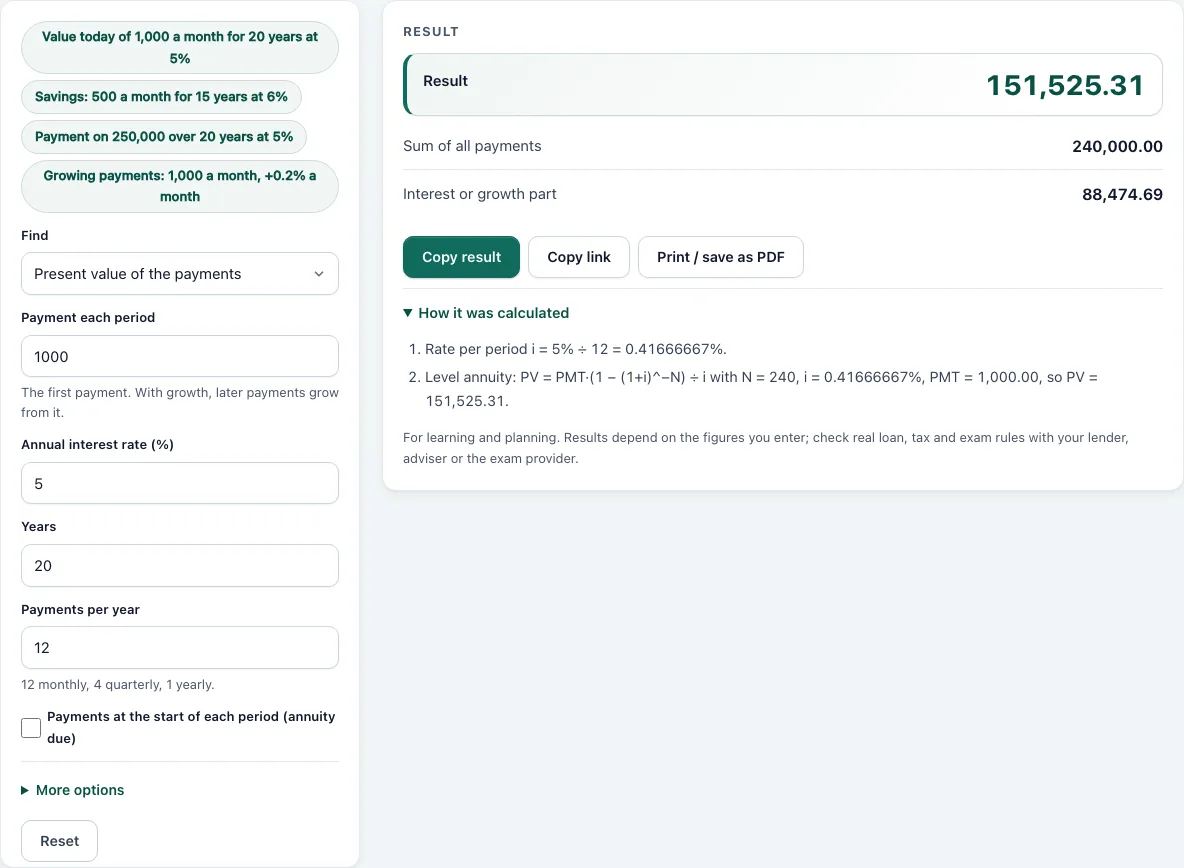
How to use the Annuity Calculator
- In Find, choose the present value of the payments, their future value, or the payment from a present value.
- Enter the Payment each period, or, if you are finding the payment, the Present value (amount to pay out).
- Enter the Annual interest rate and the Years.
- Set Payments per year: 12 for monthly, 4 for quarterly, 1 for yearly.
- Tick Payments at the start of each period for an annuity due.
- Under More options, enter a Payment growth per period if each payment is larger than the last. Leave it at 0 for a level annuity.
- Read the result, the sum of all payments and the interest part, then open How it was calculated.
The example buttons load the value of a monthly pension, a savings plan, the payment on a 250,000 amount and a growing payment stream.
To compare a lump sum with an annuity, find the present value of the payments at your required return. To see how long savings last when you withdraw a fixed amount, use the TVM calculator and solve for the number of periods.
Switching between the three choices keeps your other entries, so you can find the present value first and then the payment it would support without retyping the rate and years.
Annuity formulas
With a payment PMT, a rate i per period and N payments:
- Present value (ordinary): PV = PMT·(1 − (1+i)^−N) ÷ i
- Future value (ordinary): FV = PMT·((1+i)^N − 1) ÷ i
- Payment from a present value: PMT = PV·i ÷ (1 − (1+i)^−N)
An annuity due multiplies the ordinary present or future value by (1+i). For payments that grow by g each period the present value is PMT·(1 − ((1+g)/(1+i))^N) ÷ (i − g).
Worked examples
| Case | Inputs | Result |
|---|---|---|
| Present value of a pension | 1,000 a month, 5%, 20 years | 151,525.31 |
| Same, payments at the start | 1,000 a month, 5%, 20 years | 152,156.67 |
| Future value of savings | 500 a month, 6%, 15 years | 145,409.36 |
| Payment on a 250,000 amount | 5%, 20 years, monthly | 1,649.89 |
| Growing payments | 1,000 a month, +0.2% a month, 5%, 20 years | 186,705.47 |
Annuity versus annuity due
An annuity due pays one period earlier, so every payment earns or costs one more period of interest. That is why the second row is larger than the first by exactly one month of interest on the whole stream. Rent, insurance premiums and leases are usually paid at the start of the period, so they are annuities due. Loan repayments and most pensions in arrears are ordinary annuities. The difference matters most for long terms and high rates.
Annuity payment calculator: how much can I withdraw each year?
Choose Payment from a present value. The payment is the level amount a pot can pay out over a set number of years until it is used up. A pot of 100,000 earning 5% a year can pay 8,024.26 a year for 20 years, with each payment made at the end of the year. A larger pot or a shorter term raises the payment; a higher rate does too.
How to read the result
- Present value of an annuity is the single sum today that is equivalent to the payments. It answers questions such as what a pension is worth, how large a loan the payments support, or whether a lump sum offer is fair.
- Future value of an annuity is the balance after the last payment when each payment is invested at the rate. It answers what a savings plan will reach.
- Payment from a present value is the level payment that repays a loan or draws down a pot over the term.
What the calculator leaves out
The result is pre-tax and does not model inflation, fees or the chance that payments stop early. For a growing annuity the calculator assumes the growth lasts for every payment. A payout quote from an insurer will differ because it prices in mortality and expenses.
Frequently asked questions
Is this the same as an insurance annuity quote?
No. An insurer’s quote also depends on age, mortality, fees and its own pricing. This calculator does the time-value arithmetic only.
What is a growing annuity?
An annuity whose payments rise by a fixed percentage each period, such as a pension that follows inflation. Enter the growth under More options and the present value uses PMT·(1 − ((1+g)/(1+i))^N) ÷ (i − g).
How do I find the number of payments or the rate?
Use the TVM calculator, which can solve for N or the interest rate as well.
What does payment growth mean?
Each payment is that percentage larger than the one before. It models an income that rises with inflation or a lease with scheduled increases.
Can I calculate how long my savings will last?
Yes, with the TVM calculator: enter the pot as the present value, the withdrawal as the payment, and solve for the number of periods.
What payment growth should I use?
For an income meant to keep pace with prices, use expected inflation per period, for example 0.2% a month for about 2.4% a year.
Is the growth rate compounded?
Yes. Each payment is the previous payment multiplied by one plus the growth rate, so growth compounds along with the interest.
- TVM Calculator: solve any one of N, I/Y, PV, PMT or FV
- Future Value Calculator: what a sum and regular deposits grow to
- Present Value Calculator: what a future amount is worth today
- Perpetuity Calculator: value of payments that never end
- Sinking Fund Calculator: the deposit that reaches a target
- Effective Annual Rate Calculator: the yearly rate behind a nominal rate and its compounding
- Bond Price Calculator: clean and dirty price from the yield
- The TVMStack app: the planned app that adds cash flows, NPV and IRR
- About the tools: how the results are computed and tested